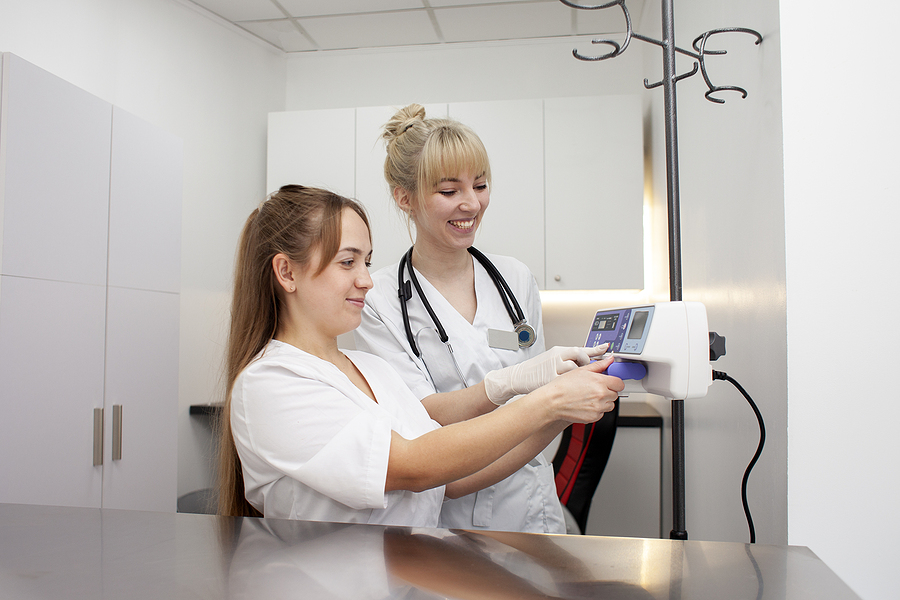
Medical assisting in Florida has shifted from a front-desk add-on to the evolving role of medical assistants that outpatient employers cannot staff fast enough. Primary care, urgent care, and specialty groups now expect MAs to draw blood, record ECGs, handle prior authorizations, and manage electronic health records while certificate costs run from roughly $3,000 at a public technical college to well above $15,000 at a private school.
The eight ranked programs sort out costs, Medical Assistant Salary outcomes, formats, and certification paths. Certification matters because Florida has no state license, so CMA, RMA, or CCMA credentials often decide interviews. Weak exam preparation can leave graduates without the credential that Florida employers expect.
Top 8 Medical Assistant Programs in Florida: Ranked & Reviewed
These eight Florida medical assistant programs stood out for combining manageable costs, strong completion outcomes, and flexible formats that work for adult learners. Each entry highlights what makes the school a practical choice, from accelerated timelines to bilingual instruction and hands-on externships.
FVI School of Nursing and Technology
#1Miami, FL · $35,000 – $40,000/yr
Best for: Bilingual students needing flexible scheduling
FVI School of Nursing and Technology in Miami pairs a fast nine-month medical assisting track with bilingual support and rolling admissions. The program blends live online classes with on-campus labs and a 180-hour externship. Its effective net price is about $35,514, and the school reports an 89.3% institution-wide graduation rate.
- Nine-month hybrid format with live online and on-campus labs
- 180-hour supervised externship included
- Bilingual English and Spanish instruction available
- Day and evening class options
- Rolling admissions offered
- Prepares for NRCMA, NRCEKG, and NRCPT certifications
Fort Myers Technical College
#2Fort Myers, FL
Best for: Students wanting weekday clinical training
Fort Myers Technical College offers an affordable campus-based medical assisting certificate with a Monday through Friday schedule. The 1,300-clock-hour program includes phlebotomy, EKG, and medical office training. Although the program lists tuition around $6,664, federal data shows an effective net price of about $40,082, and the institution's graduation rate is 81.1%.
- $6,664 total program tuition
- 1,300 total clock hours
- Monday through Friday daytime schedule
- Prepares for CCMA, CPT, and CET certifications
- Includes practicum experience and infection control training
SABER College
#3Miami, FL · $10,000 – $15,000/yr
Best for: Career changers wanting hybrid associate training
SABER College in Miami offers an Associate of Science in Medical Assisting with a hybrid format that combines online theory and on-campus labs. The 64-credit program includes 1,170 clock hours and a 180-hour externship. Its effective net price is approximately $11,009, and the institution's graduation rate is 60.8%.
- 64 total credit hours and 1,170 clock hours
- Hybrid online and on-campus format
- 180-hour externship experience
- Covers phlebotomy, EKG, billing, coding, and EHR management
- Small class sizes and career support services
Manatee Technical College
#4Bradenton, FL · $2,000/yr
Manatee Technical College in Bradenton offers a CAAHEP-accredited hybrid medical assisting certificate that can be completed in six months. The program includes 190 clinical hours and prepares students for CCMA, CET, and phlebotomy credentials. Its effective net price is around $1,808, and the institution reports a 64.0% graduation rate.
- CAAHEP accredited program
- Six-month completion timeline
- 190 clinical hours included
- Prepares for CCMA, CET, and phlebotomy certifications
- 92% job placement rate over five years
- Estimated total cost around $6,791
Atlantic Technical College
#5Coconut Creek, FL · $10,000/yr
Atlantic Technical College in Coconut Creek offers a 12-month hybrid medical assisting certificate with a full-time weekday schedule. The program covers phlebotomy, EKG, X-ray, patient care, and medical office skills. Its effective net price is about $10,414, and the institution's graduation rate is 65.3%.
- 12-month full-time schedule
- Clinical externship included
- Phlebotomy, EKG, and X-ray training
- College credit transfer opportunity available
- CPR and BLS certification included
- Background check and drug screening required
William T McFatter Technical College
#6Davie, FL · $10,000 – $15,000/yr
William T McFatter Technical College in Davie offers a CAAHEP-accredited hybrid medical assisting certificate that can be completed in 10 months. The program includes a 200-hour practicum and prepares graduates for CMA and RMA credentials. Its effective net price is about $11,901, and the institution reports a 66.3% graduation rate.
- CAAHEP accredited program
- 10-month completion timeline
- 200-hour off-campus practicum
- Prepares for CMA and RMA certifications
- 84.11% five-year exam passage rate
- Tuesday through Thursday classes with online components
ATA Career Education
#7Spring Hill, FL · $28,000/yr
ATA Career Education in Spring Hill offers an Associate of Science program that combines limited medical radiography with medical assisting. The 17-month hybrid program includes day classes and career placement support. Its effective net price is about $28,250, and the institution reports a 66.7% graduation rate.
- 17-month associate degree program
- Dual focus on limited medical radiography and medical assisting
- Blends online classes with campus labs
- Approved by Florida Department of Health
- Prepares for Florida Limited Radiography exam and CMA via NCCT
- Day classes and career placement assistance
St Petersburg College
#8St. Petersburg, FL · $1,000/yr
St Petersburg College offers a Clinical Medical Assistant certificate through its Workforce Institute in a hybrid format. The program can be completed in less than five months and includes online coursework, hands-on labs, and an externship. Its effective net price is approximately $1,471, and the institution's graduation rate is 38.3%.
- Complete in less than five months
- Hybrid online, lab, and externship format
- Prepares for national CMA certification
- Covers vital signs, injections, EKGs, and phlebotomy
- Electronic health records training included
What You'll Pay: Medical Assistant Program Costs in Florida
The table below shows the eight most affordable medical assistant programs in Florida when ranked by effective net price, which is the average cost after grants and scholarships are applied for in-state students. In-state tuition across these programs typically runs from about $2,700 to $6,600, but your actual net price can be lower or higher depending on your financial aid eligibility, household income, and other factors.
| School | City | Format | Net Price (Effective) | Tuition (In-State) |
|---|---|---|---|---|
| Indian River State College | Fort Pierce | Campus | $3,815 | $2,764 |
| Pasco-Hernando State College | New Port Richey | Campus | $5,203 | $3,155 |
| Lake-Sumter State College | Leesburg | Online | $5,855 | $3,292 |
| Eastern Florida State College | Melbourne | Hybrid | $6,440 | $2,791 |
| Daytona State College | Daytona Beach | Campus | $7,177 | $3,106 |
| Florida International University | Miami | Online | $9,288 | $6,565 |
| University of West Florida | Pensacola | Hybrid | $9,364 | $5,776 |
| University of North Florida | Jacksonville | Online | $10,154 | $5,964 |
Online Vs. On-Campus Medical Assistant Programs in Florida: How to Choose
Can I take medical assistant classes online in Florida, and how do online, on-campus, and hybrid options compare for someone balancing work, family, or a commute? Yes. In the schools reviewed for this guide, five are online, five are campus-based, and two are blended or hybrid. Your best fit depends less on rankings and more on how you learn clinical skills and how much structure you need.
What online programs get right
Online Medical Assistant Certificate and Diploma Programs in Florida tend to be the most flexible option. Many are self-paced with 12-month access, no prerequisites, and open enrollment, which makes them easier to start while working. Several also bundle the Medical Assistant Certification exam voucher into tuition. That convenience can be a real advantage for career changers or parents who cannot drive to campus multiple days a week.
Why on-campus programs still matter
Medical assisting is hands-on work. Campus-based programs give you scheduled, supervised practice with phlebotomy, EKG, patient intake, and exam-room skills before you ever face an employer. They also create natural peer and instructor connections that can help with references and job leads. The trade-off is less flexibility: you are tied to class times, a campus location, and often a daytime schedule.
How hybrid programs split the difference
Hybrid programs combine online coursework with in-person labs or clinical training. For example, Eastern Florida State College leans on hybrid delivery for its medical assisting pathway, and the University of West Florida pairs classroom instruction with hands-on clinical experience. This model can work well if you want some scheduling freedom but still need supervised practice.
The externship rule to remember
Online does not mean hands-off. An accredited program still has to include an in-person medical assistant externship or arranged clinical experience, because no amount of self-paced modules can replace direct patient contact. Before you enroll online, ask the school how it helps you secure that externship near you and whether the hours are arranged or optional.
Questions to Ask Yourself
Medical Assistant Certification in Florida: CMA, RMA, CCMA, and No State License
Florida does not require medical assistants to hold a state license, which means you can legally work as an MA without any certification at all. In practice, however, most Florida employers expect you to hold one of the recognized Medical Assistant Certifications, and some will give newly hired graduates a deadline (often 60 days) to pass an exam if they have not already done so.
Do I Need to Be Certified to Work as a Medical Assistant in Florida?
Not by law, but almost certainly by employer policy. Hospital systems such as HCA, health networks like Tallahassee Memorial HealthCare, and specialty practices such as Florida Cancer Specialists all list active certification as a hiring requirement. Job postings in Florida commonly accept credentials from multiple boards, so the question is less "which one?" and more "do you have one?"
Comparing the Four Main Credentials
- CMA (AAMA): Requires graduation from a CAAHEP- or ABHES-accredited program.1 Renew every 60 months with 60 continuing-education points, including at least 10 in each of the general, administrative, and clinical categories. At least 30 points must be AAMA-approved. If your certification lapses more than three months, you must retake the exam; the How Hard Is the CMA Exam guide can help you prepare.
- RMA (AMT): Offers multiple eligibility routes: an accredited program, five years of qualifying work experience within the past seven years, military medical training, or teaching experience. Renew every three years through a recertification exam or the AMT Certification Continuation Program.2
- CCMA (NHA): Accepts candidates with a recent MA program (completed within five years) or qualifying work experience. You need a high school diploma or GED.4 Renewal requirements are currently in flux: some sources cite every two years with 10 continuing-education credits and a fee around $99,3 while NHA materials reference a five-year cycle.4 Confirm details directly with NHA before planning your timeline.
- NCMA (NCCT): Widely accepted in Florida, but eligibility and renewal specifics vary; check with NCCT for current requirements.
What Florida Employers Actually Prefer
No statewide survey quantifies credential preferences, but job listings reveal patterns. Tallahassee Memorial HealthCare favors CCMA or RMA.5 HCA accepts CMA, RMA, CCMA, NCMA, and NRCMA. Some University of Florida positions specifically require CMA. Florida Cancer Specialists accepts any of the five major boards.7 The safest strategy: complete a program accredited by CAAHEP or ABHES so you qualify for whichever exam your target employer values most.
Florida Certification Snapshot: No State License Required
How to Choose an Accredited Medical Assistant Program in Florida (And How Long It Takes)
The choice between a faster certificate and a longer associate degree, the Medical Assistant Certificate vs. Associate's Degrees decision, often comes down to how quickly you want to enter the workforce versus whether you want additional credentials that may help with career advancement later.
Why Accreditation Matters
Two national accrediting bodies matter most for medical assistant programs: CAAHEP (Commission on Accreditation of Allied Health Education Programs) and ABHES (Accrediting Bureau of Health Education Schools). Graduating from a program accredited by either organization makes you eligible to sit for the CMA (AAMA) certification exam, which is one of the most widely recognized credentials in the field.
Florida has roughly 27 accredited medical assistant programs as of 20261, though the split between CAAHEP and ABHES is not officially published. Before enrolling anywhere, check the current CAAHEP or ABHES directory directly rather than relying on older third-party lists, which can be outdated.
If you are considering the CCMA (Certified Clinical Medical Assistant) credential through NHA instead, the eligibility requirements are less strict and do not require CAAHEP or ABHES accreditation. However, many employers still prefer candidates from accredited programs regardless of which certification they hold.
Certificate vs. Associate Degree Timelines
Certificate programs in Florida typically run between 7 and 12 months. Some examples:
- Northland offers a 7-month certificate with 160 externship hours1
- FVI School of Nursing runs a 9-month program requiring 180 clinical hours
- Broward-Miami Health Institute has a 12-month track with 230 externship hours
Medical Assistant Associate's Degree Programs generally take 18 to 24 months and include general education coursework alongside clinical training. Specific externship requirements for associate programs vary by school.
Clinical Externship Hours
Accredited programs require hands-on clinical experience, though the exact hours differ. Florida programs commonly require between 160 and 230 externship hours based on reported program requirements. Healthcare Vocational Training Institute requires 200 hours, while Concorde Career Institute Miramar requires 230 hours.
These externships are typically unpaid and completed at local healthcare facilities near the end of your training.
Verify Before You Enroll
Always confirm accreditation status directly with the school and cross-reference it against the official CAAHEP or ABHES directories. Ask admissions specifically whether completing the program qualifies you for the CMA exam, the CCMA exam, or both.
Certification Exam Pass Rates and Job Placement: What Florida Schools Report
What exam pass rates and job placement numbers do Florida medical assistant programs report, and how do you find them? The honest answer is that Florida has no single public database for CMA, RMA, or CCMA first-time pass rates. Many medical assistant schools do not publish outcomes at all, and certifying bodies and state agencies do not release program-level results in a searchable form. Programs accredited by CAAHEP or ABHES do collect outcomes through annual reports, but those reports are not compiled into one statewide list.
What Keiser's disclosures show
CAAHEP-accredited Keiser University is one of the few Florida programs that posts outcomes. Its medical assisting program reports job placement rates of 83.33% for 2021, 92.31% for 2022, and 100% for both 2023 and 2024. The five-year average sits at 87.50%.1 Keiser's Daytona Beach location reports a composite exam pass rate of 97.56%, with a five-year average of 99.51% across CMA, RMA, NCMA, CCMA, and CMAC exams.2 These composite figures do not separate pass rates by exam type.
Why self-reported numbers need context
Keep in mind that pass rates and job placement figures are usually self-reported by schools. A program may count only graduates who take an exam within a specific window or report placement for survey respondents rather than every graduate. That does not make the data wrong, but it means two schools may use different definitions of job placement. For context, national first-time CMA pass rates generally fall around 65 to 70 percent, but that national average does not tell you how a specific Florida cohort performed.
Ask for the most recent cohort
Before enrolling in a program to become a medical assistant, ask for its latest outcomes report. Request the most recent available year, not just a multi-year average, and ask whether the pass rate is first-time or includes retakes. Use these direct questions:
- What was your most recent first-time CMA, RMA, or CCMA pass rate?
- What share of graduates found jobs in medical assisting within six months?
- How many graduates were surveyed, and what period does the data cover?
If a school cannot produce a recent outcomes report, treat that as useful information in your decision.
Financial Aid and Scholarships for Florida Medical Assistant Students
How do you actually pay for medical assistant programs in Florida when tuition, uniforms, and exam fees start adding up? The good news is that most accredited MA programs qualify for a mix of federal, state, and local aid, and the sticker price is rarely what you end up owing.
Start with the FAFSA
File the Free Application for Federal Student Aid at studentaid.gov as your first step. It unlocks nearly every other form of assistance, and the 2026-2027 FAFSA deadline is June 30, 2027. Based on your results, you may qualify for:
- Pell Grant: Up to $7,395 for the 2026-2027 award year, and you do not pay it back.
- FSEOG: A supplemental grant for high-need students, typically $100 to $4,000.
- Federal student loans: Subsidized and unsubsidized options for eligible certificate and medical assistant associate's degree programs.
Florida-specific grants
Florida does not have one statewide MA scholarship, but several targeted funds can apply:
- FSAG-CE (Florida Student Assistance Grant, Career Education): Need-based aid for Florida residents of at least one year,2 enrolled at least half-time in an eligible certificate program (180 clock hours or 6 credits per term).1 Typical awards range from $200 to $2,610 per year.
- WIOA workforce funding: Administered regionally through CareerSource, this can cover up to $7,000 in tuition plus books, uniforms, and supplies. It is first-come, first-served, so apply early.
- Sunshine Health Grant (FSCJ): Up to $1,000 for in-demand medical health care programs.
- Open Door Grant (Miami Dade College): Up to $3,000 for Florida residents who are unemployed, underemployed, or furloughed and enrolled in qualifying non-credit programs like CCMA prep.
Payment plans and employer help
Most colleges offer interest-free monthly payment plans that split tuition across the term. If you already work in healthcare, ask HR about tuition reimbursement, as many clinics and hospital systems will fund part of an MA credential.
When comparing programs, look at your net price after grants, not the published tuition. Two schools with very different sticker prices can end up costing you nearly the same out of pocket.
Related Articles
Additional Medical Assistant Programs in Florida to Consider
Our ranked list covers eight standout programs, but Florida has many more options worth a look. This directory highlights a few more schools, with the city, format, and effective net price for each. Use it as a starting point, then request information directly from any program that fits your budget and schedule.
South Florida
- Medical Assistant Diploma
- Medical Assisting Career Technical Certificate
Central Florida
- Medical Assisting Associate of Occupational Studies Degree
- Associate in Science in Medical Assisting
- Medical Assisting Diploma Program
State by State
- Alabama
- Alaska
- Arizona
- Arkansas
- California
- Colorado
- Connecticut
- Delaware
- Georgia
- Hawaii
- Idaho
- Illinois
- Indiana
- Iowa
- Kansas
- Kentucky
- Louisiana
- Maine
- Maryland
- Massachusetts
- Michigan
- Minnesota
- Mississippi
- Missouri
- Montana
- Nebraska
- Nevada
- New Hampshire
- New Jersey
- New Mexico
- New York
- North Carolina
- North Dakota
- Ohio
- Oklahoma
- Oregon
- Pennsylvania
- Rhode Island
- South Carolina
- South Dakota
- Tennessee
- Texas
- Utah
- Vermont
- Virginia
- Washington
- Washington DC
- West Virginia
- Wisconsin
- Wyoming