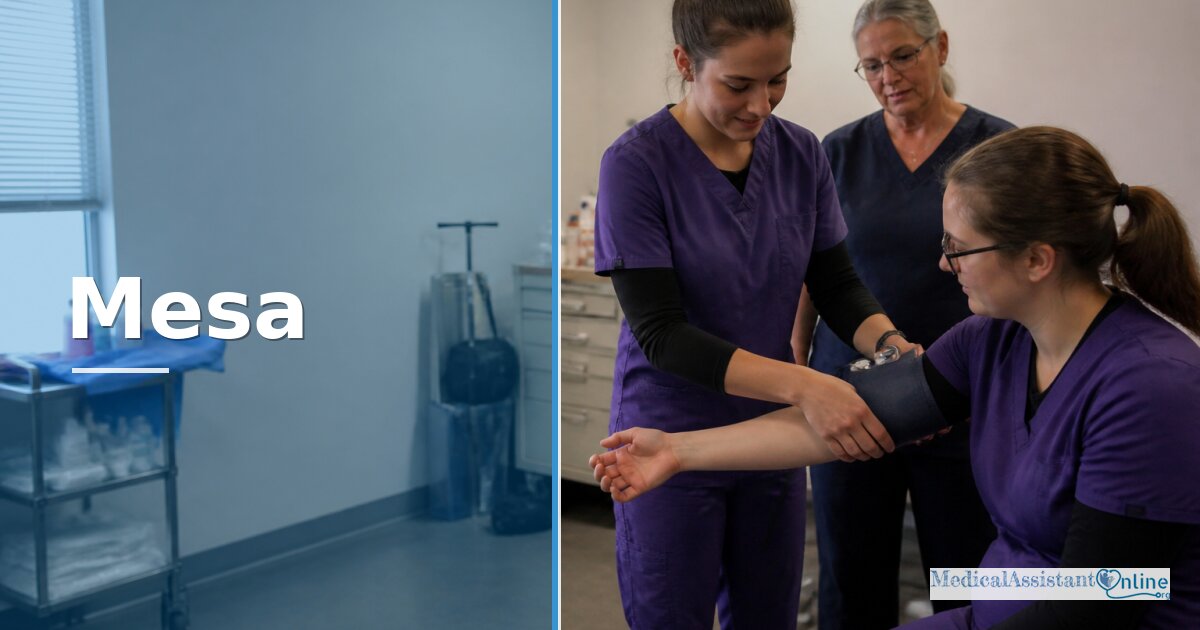
Healthcare hiring across the East Valley continues to outpace the state average, with Banner Health, HonorHealth, and Phoenix Children's routinely posting medical assistant openings at Mesa-area clinics and specialty offices. For career changers, recent high school graduates, and working adults weighing a move into the field, the real challenge is sorting through program formats, costs that range from roughly $4,000 to over $18,000, and certification options that directly affect starting pay.
Below you will find accredited program details, training timelines, externship expectations, and current salary data for the Phoenix-Mesa metro, all organized so you can compare options side by side.
Medical Assisting in Mesa: Employers, Scope of Practice, and Day-To-Day Work
Phoenix Children's is currently hiring a lead pediatric medical assistant for its pediatric GI clinic at 5131 E Southern Ave in Mesa1, one of hundreds of openings that surface across the East Valley in a given month.2 Banner Health, HonorHealth, and Terros Health also post regularly for MA roles spanning Phoenix and Mesa locations, alongside smaller specialty practices like OrthoArizona, Western Vascular Institute, and Arcadia Foot & Ankle.
What the Job Actually Looks Like
On a typical shift you'll room patients, take vitals, prep exam rooms, and document everything in the electronic health record. Depending on the practice, you may draw blood, run EKGs, give injections under a provider's order, or collect specimens for lab work. Front-office tasks like scheduling, insurance verification, and patient intake often fall on clinical medical assistants too, especially in smaller clinics where staff wear multiple hats.
Scope of Practice in Arizona
Arizona does not require a state license to work as a medical assistant, but that doesn't mean the role is unsupervised. You perform delegated clinical tasks under a physician, physician assistant, or nurse practitioner, and you're expected to stay within the boundaries of your training and certification. That means no independent diagnosing, no prescribing, and no invasive procedures beyond what's been delegated and trained. Employers vary in how closely they define these limits, so job postings are worth reading carefully.
Where the Growth Is
Mesa, Gilbert, and Chandler have seen a steady rise in urgent cares, specialty practices, and outpatient clinics, and postings reflect that breadth: cardiology, dermatology, urology, allergy, infusion therapy, and pediatrics all show up regularly alongside primary care.3 That range gives newly certified MAs real flexibility in choosing a specialty that fits their interests.
Online and Hybrid Medical Assistant Programs Serving Mesa Students
If commuting to a traditional daytime program doesn't fit your life, a hybrid or online medical assistant program can be a strong alternative. Coursework happens on your schedule, while the hands-on pieces (labs, injections, EKGs, phlebotomy) and the clinical externship still happen in person at partner sites across the East Valley.
Hybrid Options Close to Home
Carrington College-Mesa runs a hybrid medical assisting program from its 85210 campus. Didactic modules are delivered online, and students come to campus for skills labs before completing an in-person externship at a local clinic or physician's office. After typical aid, program cost is about $36,700, and federal financial aid and scholarships are available to qualifying students.
Phoenix College offers an Associate in Applied Science in Medical Assisting through the Maricopa system, with courses delivered online and clinical practicum requirements completed in the Valley. Effective net price is about $12,100, making it one of the more affordable routes for Mesa residents who want a two-year degree rather than a certificate.
Fully Online Coursework
Bryan University in Tempe offers a Clinical Medical Assistant Certificate built for working adults: 30 credit hours, personalized coaching, and online simulations, paired with 120 supervised clinical hours you complete at an approved site. Effective net price is roughly $40,300.
What to Expect
No medical assistant program is 100% remote. Every accredited path requires supervised clinical hours on real patients. If you already have healthcare experience (CNA, EMT, phlebotomy), ask each admissions office about credit for prior learning before you enroll. It can shorten your timeline meaningfully.
Mesa Medical Assistant Program Costs and Financial Aid
This table ranks Mesa-area medical assistant programs by net price, which is the estimated cost after institutional aid and is a better comparison than published tuition alone. For 2026, Pima Medical Institute-Mesa lists a total program cost of $18,459 (tuition $17,152, registration fee $150, textbooks $727, uniform $165, technology fee $265), and the Mesa AZ Job Connection program lists a total of $20,900 (tuition $20,447.43 plus $289.11 in supplies and materials). Phoenix Medical Assistant School's Mesa campus lists tuition at $3,490 with weekly payment plans, while Arizona College Mesa is listed around $11,895 from a third-party directory; financial aid options include the Federal Pell Grant, FSEOG, Federal Work-Study, Direct Loans, institutional scholarships, payment plans, and WIOA workforce funding for eligible students.
| School | City | State | Net price after institutional aid |
|---|---|---|---|
| Phoenix College | Phoenix | AZ | 12,055 |
| Chandler-Gilbert Community College | Chandler | AZ | 12,726 |
| GateWay Community College | Phoenix | AZ | 13,339 |
| Bryan University | Tempe | AZ | 20,834 |
| Pima Medical Institute-Mesa | Mesa | AZ | 21,461 |
| Brookline College-Tempe | Tempe | AZ | 22,297 |
| Pima Medical Institute-East Valley | Mesa | AZ | 22,453 |
| Pima Medical Institute-Phoenix | Phoenix | AZ | 23,004 |
| Carrington College-Mesa | Mesa | AZ | 48,877 |
Related Articles
How Long Does Medical Assistant Training Take in Mesa?
Medical assistant training in Mesa falls into three clear time buckets, and the right one for you depends on how fast you want to work, whether you want a college degree, and which certification exam you're aiming for.
The three length bands
- Accelerated diploma (about 18 to 22 weeks): The fastest route. Phoenix Medical Assistant School runs an 18-week track1, and Arizona College's Mesa diploma takes 31 weeks (roughly seven months), including a 5-week clinical externship2 and 720 total program hours.3
- Certificate or diploma (6 to 9 months): A middle path. Pima Medical Institute's certificate runs about 9 months4, and Altrain Assisting Academy's 4-month program packs in 84 clinical hours and 24 phlebotomy hours.5
- Associate degree (up to 2 years): Semester-based tracks that add general education courses alongside clinical training.
Duration, credentials, and schedule
Shorter diplomas typically prepare graduates for CCMA or RMA-style exams, while longer accredited programs, like Arizona College's ABHES-accredited Mesa program2, allow graduates to sit for the RMA or the CMA (AAMA) exam. Day, evening, and hybrid schedules are common, and some Mesa-area schools offer part-time tracks for working adults.
One caution: shorter isn't automatically better. Accreditation and externship hours matter more than raw weeks on paper, because employers screen for both when hiring.
Getting In: Admission Requirements and Application Process for Mesa MA Programs
High school and adult applicants enter Mesa medical assistant programs through different doors, and the paperwork changes with the path. High school students in eligible East Valley districts such as Mesa, Gilbert, Chandler, Tempe, and Scottsdale can apply to East Valley Institute of Technology, or EVIT, through EVIT admissions. They typically provide attendance and discipline records, unofficial transcripts, and immunization proof. Adult learners generally need a high school diploma or GED and are usually at least 18.1 EVIT adult students may also provide transcripts with a projected graduation date and complete fingerprint clearance if they are 22 or older, as detailed by EVIT adult admissions. Adult EVIT enrollment is often open-entry and tuition-based rather than tied to a district seat.
Common Health and Safety Paperwork
Across Mesa programs, expect a background check1 and often a drug screen.2 Immunization records are standard, and some schools list annual flu, Tdap, MMR, hepatitis B, varicella, and TB screening requirements.2 CPR certification may be requested before clinicals. Placement testing varies: some programs use basic skills checks, while others do not require an entrance exam.
Typical Application Steps
The general process moves from online application and document upload to an interview or advising conversation, then an enrollment agreement, financial aid meeting, and orientation. If a program lists prerequisites, English and science readiness is the most common ask, and West-MEC Medical Assisting Program expects one credit of English and one credit of Science with a C or better. Some schools also fold medical terminology and anatomy into the core before clinicals.
Clinical Externships and Hands-On Training in Mesa
How many hours will you actually spend in a real clinic before you graduate, and how can you survive your medical assistant externship? For most Mesa medical assistant programs, the answer lands somewhere between 160 and 250 hours, and those hours are almost always unpaid.
What to Expect at Your Site
Externship length varies by program. The AZ Job Connection program on West Southern Avenue in Mesa builds in a 250-hour externship during its final module, part of a 36-week, 810-hour curriculum.1 Herzing's Arizona program runs 180 hours across an eight-week final term,5 and Mohave Community College splits its 180 hours evenly between clinical and front-office work.3 UEI College Mesa's Medical Assistant Program in Mesa includes an externship inside its 10-month program but doesn't publish an hour count. Pima Medical Institute Mesa folds clinical externships into its 35-week program.2
Placements typically happen in family practice, internal medicine, pediatrics, urgent care, cardiology, and orthopedic clinics across the East Valley. Mayo Clinic Arizona hosts externs in Phoenix and Scottsdale through partnerships with Gateway Community College, Phoenix College, and West-MEC.4
Questions to Ask Before You Enroll
- Does the school place you, or are you responsible for finding a site? Herzing, for example, expects the student to secure the location.5
- Is placement guaranteed, or just assisted?
- What percentage of students start their externship within 30 days of finishing coursework?
Medical Assistant Salary and Career Outlook in Mesa (Phoenix Metro)
In the Phoenix-Mesa-Chandler metro area, BLS reports 17,230 medical assistant jobs and a median annual wage of $46,090, equal to roughly $22.16 per hour. That places the Mesa area at the top of Arizona's reported metro medians, ahead of Prescott Valley-Prescott ($45,140), Flagstaff ($44,410), and Tucson ($42,900). State and national median comparisons are not available from the latest metro-level release.
| Location | Medical assistant employment | Median annual wage | Median hourly wage (approx.) |
|---|---|---|---|
| Phoenix-Mesa-Chandler, AZ | 17,230 | $46,090 | $22.16 |
| Tucson, AZ | 3,140 | $42,900 | $20.63 |
| Prescott Valley-Prescott, AZ | 600 | $45,140 | $21.70 |
| Lake Havasu City-Kingman, AZ | 510 | $41,890 | $20.14 |
| Yuma, AZ | 440 | $38,630 | $18.57 |
| Flagstaff, AZ | 360 | $44,410 | $21.35 |
| Sierra Vista-Douglas, AZ | 260 | $39,920 | $19.19 |
Medical assistants in the Phoenix-Mesa-Scottsdale metro earn a median annual wage of $41,600, or about $20 an hour.
How to Become a Medical Assistant in Arizona: Certification Roadmap
Do you need a state license to work as a medical assistant in Arizona?
No. Arizona does not require a state license or registration for medical assistants.1 Instead, employers in Mesa commonly expect you to finish an approved training program and earn a national certification, often within the first 90 days of hire.
The Standard Path
- Complete a high school diploma or GED first.1
- Graduate from an accredited medical assistant program, typically a certificate or associate degree. Some Arizona certificate programs include about 900 clock hours with clinical externship.2
- Apply for and pass one of the CMA vs RMA vs CCMA medical assistant certification options: CMA (AAMA), RMA (AMT), or CCMA (NHA).
- Meet employer-specific requirements, such as a background check, drug screen, or additional competency check.3
National Certification at a Glance
- CMA (AAMA): Requires completion of a CAAHEP- or ABHES-accredited program. No experience-only route.3
- RMA (AMT): Offers broader pathways, including accredited program, military training, apprenticeship, instructor experience, or 5 years of clinical work experience within the last 7 years.3
- CCMA (NHA): Accepts an NHA-approved or CAAHEP/ABHES-accredited program, or 1 year of full-time clinical work experience.4
Phlebotomy or EKG skills performed independently may require separate state certification, but they do not require it when done within a medical assistant's delegated scope under a supervising provider, as outlined in the Arizona Medical Assistant Rules.
Top Medical Assistant Programs Serving Mesa Students
Below are the top medical assistant programs serving Mesa students, ranked by accreditation, program fit, and available completion data. Program-specific job placement and RMA pass rates are not consistently published; the most recent national CMA (AAMA) first-time pass rate was 69 percent for exams administered from July 2024 through April 2025. Among the top three, Pima Medical Institute-East Valley suits students who want a deep local clinical network, Pima Medical Institute-Mesa works well for hybrid learners who need a Mesa campus, and Carrington College-Mesa is a strong fit for working adults who want online coursework plus an in-person externship.
Pima Medical Institute-East Valley
#1Mesa, AZ · $22,000/yr (net price)
Best for: Mesa residents pursuing subsidized training
A nine-month Medical Assistant certificate on a Mesa campus combines clinical skills like vitals, phlebotomy, and exam assistance with clerical duties like scheduling and billing. The program includes a supervised externship in local physician offices, hospitals, or clinics, and a hybrid learning option supports East Valley students who need schedule flexibility.
- Nine-month certificate with hybrid option
- Clinical externship in local healthcare settings
- Hands-on training with real-world equipment
- Career services team supports job placement
- Covers clinical and clerical medical office skills
- Futuro Health consortium pathway may lower tuition for qualifying students
Pima Medical Institute-Mesa
#2Mesa, AZ · $21,000/yr (net price)
Best for: Hands-on learners prioritizing local clinical experience
A nine-month Medical Assistant certificate at a Mesa campus provides hands-on practice with real equipment and covers both clinical and administrative duties. Students complete a clinical externship, and a hybrid option plus career services support helps working learners and recent graduates move into local medical offices, clinics, and hospitals.
- Nine-month program with hybrid scheduling
- Clinical externship included in the curriculum
- Practice with real-world medical equipment
- Covers clinical and clerical medical office skills
- Career services support for job placement
Carrington College-Mesa
#3Mesa, AZ · $45,000 – $50,000/yr
Best for: Working adults needing hybrid flexibility
This nine-month Medical Assisting certificate pairs online coursework with an in-person externship. It covers clinical skills like vital signs, medication administration, and exam assistance, plus administrative duties such as scheduling, billing, and electronic health records. Federal financial aid and scholarships are available for qualifying students.
- Nine-month program with online coursework
- In-person externship required for clinical hours
- Entrance exam required for admission
- Eligible for federal financial aid and scholarships
- Covers administrative skills like EHR and billing
- Prepares for medical assistant certification exams
Bryan University
#4Tempe, AZ · $21,000/yr
This fully online certificate is a 10-month, 30-credit program with 120 clinical hours, online simulations, and preparation for the CCMA credential. Mesa-area students can complete coursework online while satisfying clinical experience requirements. Personalized coaching and an NCCA-accredited exam focus make it a flexible option for working adults.
- 10-month, 30-credit online program
- 120 required clinical hours
- Minimum 2.0 GPA for graduation
- Prepares for the CCMA certification exam
- Online simulations and personalized coaching
- CPR certification preparation included
Brookline College-Tempe
#5Tempe, AZ · $20,000 – $25,000/yr
A 33-week Medical Assisting diploma with hands-on labs and simulations for East Valley learners. The program covers patient interaction, medical documentation, basic coding and billing, and electronic medical records, offering a commutable option for Mesa residents seeking quick entry into clinics and physician offices.
- 33-week accelerated diploma program
- Real-world labs and simulations
- Covers coding, billing, and electronic records
- Prepares for entry-level medical assistant roles
Chandler-Gilbert Community College
#6Chandler, AZ · $2,000 – $9,000/yr
Two certificate tracks in medical assisting, one administrative and one clinical. Both include practicum hours and require CPR/BLS certification and an Arizona Level One Fingerprint Clearance Card. A transfer pathway to Northern Arizona University gives East Valley students a clear route from a certificate toward a bachelor's degree.
- 16-22 credit hours required
- Includes administrative practicum
- Requires CPR/BLS and fingerprint clearance
- Transfer pathway to NAU available
- 24 credit hours total
- Requires CPR/BLS and fingerprint clearance
- Transfer pathway to NAU available
- Clinical practicum included
GateWay Community College
#7Phoenix, AZ · $10,000 – $15,000/yr
A fast-track, cohort-based Certificate of Competency in Medical Assisting in Phoenix. The program requires 200 clinical hours and prepares students for national certification. Prerequisites, CPR/BLS certification, and a background check are required.
- Cohort-based, fast-track format
- 200 clinical hours required
- Eligible for national certification exam
- Requires CPR/BLS and background check
- Prerequisite courses required
Phoenix College
#8Phoenix, AZ · $12,000/yr (net price)
An Associate in Applied Science in Medical Assisting plus separate clinical and administrative certificate programs. The associate path includes 63-71 credits, while the certificates are shorter and include practicum components. Admission requires CPR/BLS certification and a background check, and graduates are eligible for national certification exams.
- 63-71 total credits required
- Includes administrative and clinical certificates
- Full-time or part-time study options
- Eligible for national certification exams
- Transfer pathway to bachelor's programs
- 24 credit hours
- Clinical practicum included
- Requires CPR/BLS and fingerprint clearance
- High school diploma or GED required
- Eligible for national certification exam
- Prerequisite courses required
- Prepares for Certified Medical Administrative Specialist exam
- Requires formal application and background check
- Prior learning assessment credit may be awarded
Carrington College-Phoenix North
#9Phoenix, AZ
A nine-month Medical Assisting certificate with hands-on training using EKG machines and other equipment. It prepares students for both administrative and clinical roles in physician offices, hospitals, and clinics, and serves as a Phoenix metro option for Mesa-area learners willing to commute.
- Nine-month certificate program
- Hands-on training with EKG machines and autoclaves
- Prepares for clinical and administrative roles
Pima Medical Institute-Phoenix
#10Phoenix, AZ · $23,000/yr
A nine-month Medical Assistant certificate with hybrid learning and clinical externships. The program combines clinical skills like phlebotomy and exam assistance with administrative duties such as scheduling and billing; career services support helps graduates pursue entry-level roles across the Phoenix metro.
- Nine-month program with hybrid option
- Clinical externships available
- Hands-on training with real-world equipment
- Career services support for graduates
- Prepares for physician offices, hospitals, and clinics
Frequently Asked Questions About Medical Assistant Programs in Mesa
How long does it take to become a medical assistant in Mesa?
Diploma and certificate programs in Mesa typically run about 18 weeks to 9 months. For example, Arizona College offers a 31-week diploma, Pima Medical Institute has a 9-month certificate, and Sumner College runs for 32.5 weeks.1 Associate degree paths take longer. Check individual program schedules for your pace.
What is the cheapest medical assistant program in Mesa?
Based on the cost table in this guide, the lowest confirmed total cost is about $7,985 (tuition $7,590 plus a $395 supply fee) at Medical Assisting 4 Hour Accelerated Program on West Main Street. Note that this program holds COGNIA accreditation, not ABHES or CAAHEP programmatic accreditation. No verified EVIT program cost was available.
Which medical assistant programs in Mesa are accredited?
ABHES-accredited options serving Mesa include Arizona College (31-week diploma), Pima Medical Institute's Mesa campuses (9-month certificate), and Sumner College (32.5 weeks).1 No CAAHEP-accredited Mesa location was confirmed; the nearby CAAHEP option is Central Arizona College's San Marcos Campus outside Mesa.
Do Mesa medical assistant programs include clinical externships?
Yes, most Mesa MA programs include a clinical externship. Hours and sites vary by school, but externships are usually arranged in local clinics, physician offices, and outpatient settings. The externship section of this guide explains why this hands-on rotation is often an unspoken hiring screen.
What is the starting salary for a medical assistant in Mesa?
For a local benchmark, use the BLS Phoenix-Mesa metro median for medical assistants shown in this guide's salary section, not a generic national figure. Entry-level pay in Mesa often falls below that metro median depending on facility type, certification, and prior experience. Check the salary table for the current figure.