

Medical assistants earned a national median wage of about $44,200 in May 2024, a figure that climbs or dips by more than $10,000 depending on the state and clinical setting. For career changers weighing healthcare options, that range raises a practical question: is a role you can train for in under a year in fast online medical assistant certificate programs worth the tradeoffs in pay ceiling, physical demands, and advancement?
The answer depends on priorities you may not have weighed yet. Training programs typically run 9 to 12 months, certification is optional in most states but expected by many employers, and burnout rates in high-volume clinics are real. At the same time, job openings continue to outpace supply in outpatient care, and many MAs use the credential as a stepping stone toward nursing or healthcare administration.
What Does a Medical Assistant Do?
Medical assistants have become one of the fastest-growing entry points into outpatient care, as clinics look for versatile staff who can keep both patient flow and paperwork moving. In most practices, the work splits between hands-on clinical medical assistant tasks and the front-office duties that keep a visit on schedule.
A dual clinical and administrative role
On a typical day, a medical assistant may room a patient, check vital signs, update the medical history, and prepare the exam room. In some settings they draw blood, give injections, or perform basic tests. Between patients, they often move to the other side of the desk to handle administrative medical assistant duties: scheduling follow-ups, verifying insurance, entering orders, and relaying messages between the provider and the patient.
Where medical assistants work
- Physician offices: The most common setting, with a predictable mix of scheduled appointments and in-office procedures.
- Outpatient clinics: More specialty-focused work, such as orthopedics, dermatology, or cardiology, where duties shift toward that specialty's exams.
- Urgent care: Faster pace with more varied complaints and a stronger focus on point-of-care testing.
- Hospitals: Usually more compartmentalized, with medical assistants supporting specific units or ambulatory departments.
Because medical assistants are often the first and last person a patient sees, they act as a bridge between the waiting room and the provider. That makes them a key point of contact for questions, follow-up instructions, and return visits.
Core skills for the role
- Communication: Explaining instructions clearly and relaying details accurately.
- Multitasking: Managing several patients, phone calls, and chart updates in the same hour.
- Clinical basics: Vital signs, infection control, specimen collection, and safe injection practices.
- Electronic health records: Documenting visits, scanning orders, and checking in-basket messages.
What separates a medical assistant from a nurse
Medical assistants work under the license of a provider and focus on supporting a clinic's workflow. Nurses have broader legal scope, including more advanced assessments, medication administration, and care planning. Medical assistants do not replace registered nurses; they handle the delegated clinical and administrative tasks that keep an ambulatory practice running smoothly.
Pros of Being a Medical Assistant
Medical assisting stands out as one of the fastest, most practical routes into hands-on patient care. For many aspiring healthcare workers, the pros outweigh the cons, especially when time, cost, and work-life balance matter.
Short Training, Quick Entry
Many certificate programs take just 9 to 12 months to complete. That means you can move from a first class to a first job in under a year, which is rare among direct patient care roles. Associate degree options exist too, but the certificate path is the most common way to become a medical assistant. That compressed timeline lowers the barrier to entry compared with nursing or many other allied health paths.
Strong Demand and Job Stability
Healthcare employers consistently need medical assistants. The medical assistant job outlook is projected to grow faster than the average for all occupations, driven by expanding outpatient clinics and an aging population that requires more preventive care. That growth translates into relative job security for new graduates, particularly in primary care, urgent care, and specialty offices.
Daily Variety and Real Patient Connection
Few entry-level roles blend clinical and administrative work the way medical assisting does. One morning you may room patients, record vital signs, and assist with a procedure. The next hour you could be scheduling follow-ups, updating records, or handling insurance questions. No two days look the same, which keeps the work engaging.
There is also a meaningful emotional payoff. Medical assistants are often the first friendly face a patient sees and the person who helps calm nerves before an exam. Being part of a care team and knowing your work directly supports patient comfort and safety is a powerful motivator.
Clinic-Friendly Schedules
Many medical assistants work in outpatient clinics with predictable weekday hours. While some urgent care or specialty settings require evenings or weekends, the role generally offers more regular schedules than hospital-based jobs like nursing or EMT work. That stability makes it easier to plan family time, continue schooling, or simply recharge.
Cons of Being a Medical Assistant
Some people enter medical assisting as a deliberate stepping stone, while others hope to build a long-term career in the role. The cons below matter most if you are in that second group.
Pay limitations are real
Medical assistants often earn below the national average for all occupations. In many states, medical assistant hourly pay is modest, and raises tend to be small without additional credentials. The role has a relatively flat salary curve: after a few years of experience, you may bump against a ceiling. Moving into nursing, sonography, or healthcare administration usually requires more education, not just more time on the job.
Physical demands add up
Long shifts on your feet, helping lift or position patients, and repeating tasks like drawing blood or entering vitals can wear on your back, legs, and hands. The work is not a desk job, and fatigue is common, especially in busy clinics where patient volume stays high all day.
Stress and limited autonomy
Medical assistants frequently juggle front-desk duties, phone calls, rooming patients, and clinician requests at the same time. You may feel caught between what a patient needs and what an administrative rule or schedule allows. At the same time, medical assistant scope of practice is narrower than a nurse's. You work under supervision and cannot independently perform many clinical tasks. That can be frustrating if you enjoy more decision-making authority.
Burnout and turnover are documented
Burnout and turnover are documented challenges in medical assisting. The combination of modest pay, physical strain, and high multitasking can push people out of the field within a few years. We cover burnout in more detail later, but it is worth sitting with this before you enroll in a program.
How Much Do Medical Assistants Make? State and Setting Differences
Nationally, medical assistants earned a median annual wage of about $44,200 in May 2024, but pay shifts by state and workplace, as shown below. The most recent federal employer data show outpatient care centers paying the highest mean wage at $50,250, followed by general medical and surgical hospitals at $45,760, physician offices at $42,200, and offices of other health practitioners at $37,460, a spread of about $12,790 per year. Urgent care and specialty practices are not separated in those federal figures, but 2026 salary guides put urgent care at roughly $40,000 to $46,000 and specialty practices at roughly $40,000 to $48,000, with dermatology and ophthalmology often running higher.
| State | Total Employment | Median Annual Wage |
|---|---|---|
| Washington | 18,430 | $55,120 |
| Alaska | 2,420 | $51,860 |
| Oregon | 11,610 | $49,900 |
| District of Columbia | 2,530 | $49,740 |
| Minnesota | 9,930 | $49,380 |
| Hawaii | 3,830 | $48,820 |
| Massachusetts | 16,210 | $48,540 |
| California | 110,350 | $48,050 |
| New Hampshire | 2,990 | $48,040 |
| Wisconsin | 12,900 | $47,610 |
| Colorado | 12,910 | $47,270 |
| Maine | 4,120 | $46,540 |
| Connecticut | 9,750 | $46,500 |
| New Jersey | 22,530 | $46,280 |
| Nebraska | 2,560 | $46,080 |
| New York | 39,250 | $46,040 |
| Rhode Island | 3,270 | $45,820 |
| Illinois | 22,990 | $45,490 |
| Montana | 2,290 | $45,440 |
| Arizona | 23,300 | $45,440 |
| Vermont | 1,090 | $45,330 |
| Maryland | 14,700 | $45,060 |
| Iowa | 5,260 | $43,670 |
| Nevada | 7,440 | $43,450 |
| Idaho | 5,090 | $43,400 |
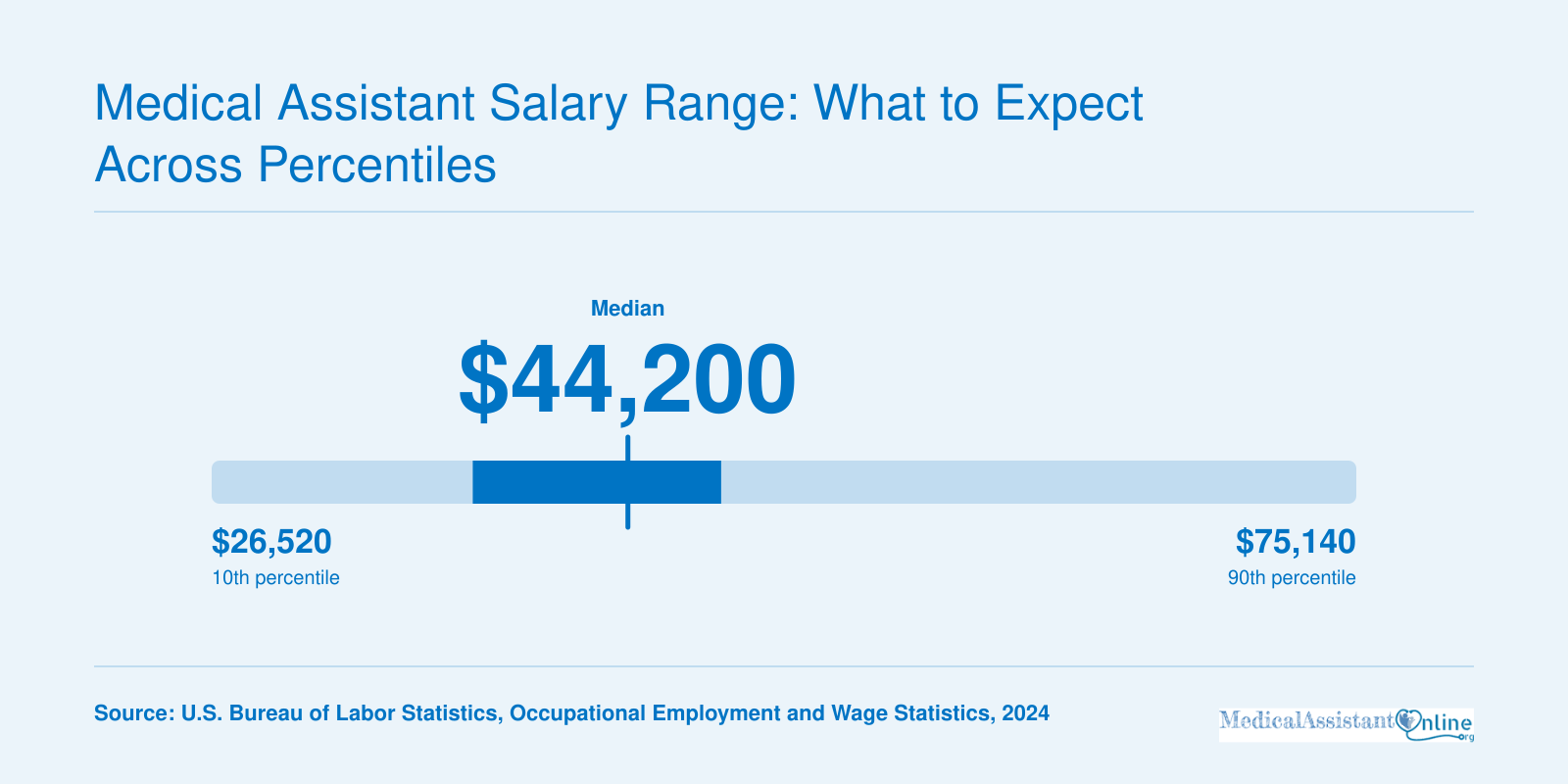
Medical Assistant Salary Range: What to Expect Across Percentiles
Pay for medical assistants varies more than the median alone suggests. The middle half of medical assistants earn between $37,610 and $48,160 per year, while experience, specialization, and location can push earnings beyond that range.
Top-Paying State for Medical Assistants
Highest-Paying Metro Area for Medical Assistants
Where you work matters nearly as much as what you do.
Medical Assistant vs CNA, Phlebotomist, EMT, and Dental Assistant: How They Compare
Some entry-level healthcare roles focus on one clinical skill, while medical assisting splits time between patient care and front-office work. That difference in day-to-day scope, explained in the Medical Assistant vs. Other Entry-Level Healthcare Programs comparison, often decides which path feels right before salary even enters the picture.
Where the roles differ
- Medical assistant: Rooms patients, takes vitals, assists with exams, and may also handle scheduling, billing, or insurance tasks.
- CNA: Spends more time on hands-on daily care such as bathing, mobility, and feeding; the Medical Assistant vs. Certified Nursing Assistant (CNA) comparison walks through how that differs from medical assisting. Pay and job outlook data for CNAs are less clear in the material we reviewed.
- Phlebotomist: Centers on blood draws and specimen handling in labs, clinics, or hospitals.
- EMT: Works in emergency response, assessment, and transport, often with irregular shifts.
- Dental assistant: Supports dentists chairside with procedures, instruments, and infection control.
Pay and growth at a glance
Use these as rough comparisons, not exact guarantees, because sources vary, especially for phlebotomy: - Medical assistant: median pay about $44,200 per year, with 12% job growth and roughly 112,300 annual openings.1 - Dental assistant: median pay about $48,070 per year, with 6.4% growth and roughly 52,900 annual openings.4 - EMT: median pay about $41,340 per year, with 5% growth and roughly 19,000 annual openings.2 - Phlebotomist: median pay about $45,230 per year, with growth estimates around 5.6% and roughly 18,400 annual openings.3 - CNA: no settled national figure from the research included here, so treat direct pay comparisons cautiously.
Which path fits you
Medical assisting is strongest when you want variety: clinical work plus the structure of a clinic or practice. EMT suits people who can handle urgent situations and nonstandard schedules. Phlebotomy fits those who want a repeatable clinical task, and dental assisting fits those drawn to dental care. If salary potential matters most, dental assistant and medical assistant figures tend to run higher than EMT in these estimates, but local demand and employer type change the picture quickly.
Related Articles
Recent Articles










- Are Medical Assistants In Demand? Job Outlook & Demand - April 17, 2026
- Medical Assistant vs CNA & Phlebotomy: Which Is Right? - March 4, 2026
- Medical Assistant vs. Nurse: Choose Your Long-Term Path - November 5, 2025