Medical assisting in Madison has shifted from an entry-level stopover into a credential-driven role inside major health systems. UW Health, SSM Health, UnityPoint Health-Meriter, and Group Health Cooperative all hire medical assistants, and the Madison metro area employed roughly 1,980 MAs at a median annual wage of $48,150.
Training routes are just as varied: Madison College's technical diploma, Herzing University's private campus option, hospital apprenticeships, and employer-funded tracks each carry different costs, timelines, and certification rules. The practical choice is cost versus speed and credential portability.
The sections below compare programs, costs, certification, apprenticeships, and salaries, so you can choose a path that fits your schedule and budget.
The Madison Healthcare Landscape: Who Hires Medical Assistants?
UW Health, SSM Health, UnityPoint Health-Meriter, and Group Health Cooperative of South Central Wisconsin anchor medical assistant hiring in Madison. Across these systems, medical assistants work in hospital departments, primary care clinics, specialty practices, and outpatient surgery centers, but the strongest demand tends to sit in primary care and other outpatient settings where patient volume is steady.
Where medical assistants fit
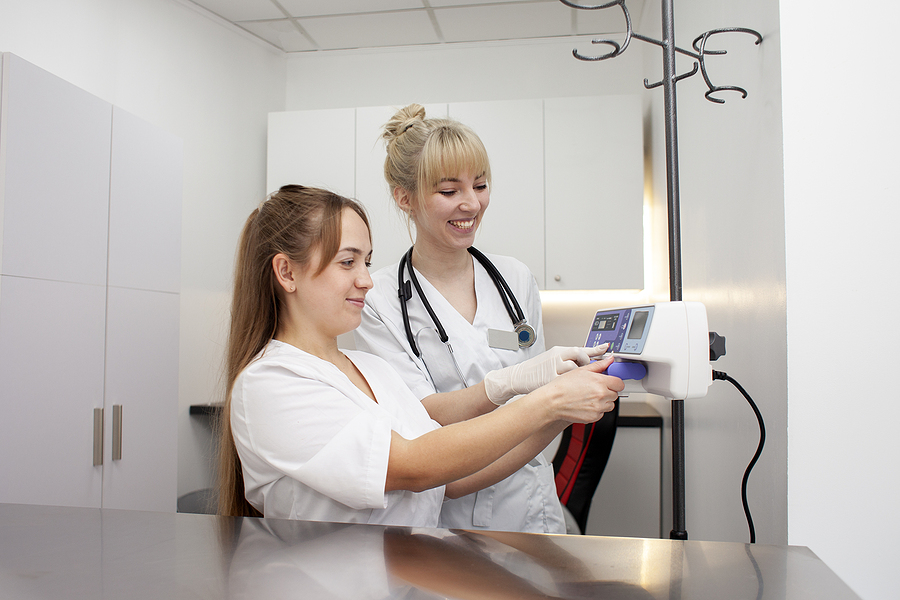
In Wisconsin, medical assistants work under provider supervision and split their time between clinical and administrative duties. A typical day may include rooming patients, taking vital signs, updating medical histories, assisting with procedures, and scheduling follow-up care. That dual skill set makes them flexible team members in both large health systems and smaller independent practices.
Primary care and outpatient demand
Primary care, family medicine, internal medicine, and pediatric clinics are especially active hiring points because they run on steady patient volume and rely on medical assistants for intake, rooming, and follow-up. Specialty practices such as cardiology, dermatology, orthopedics, and women's health also hire medical assistants, though those openings may be smaller and less frequent.
What this means for job seekers
Madison's healthcare sector is one of the largest employers in the region, creating steady entry-level openings for newly trained and certified medical assistants. Hospitals and large clinics often hire for specific departments, while community clinics and specialty offices may offer broader cross-training. Because the region supports a mix of academic medicine, community hospitals, and nonprofit health plans, students and career changers can use Medical Assistant Resources to find settings that match their preferred pace and patient population.
Medical Assistant Programs in Madison: Your Options at a Glance
This table maps the main medical assistant training pathways available to Madison-area students, including a public technical college, a private university, and a private vocational school. Costs are estimates and may change annually, so verify current tuition and fees directly with each program. Madison Area Technical College and Herzing University are the primary in-city options; regional programs can also serve Madison students.
| Program | Institution Type | Format | Estimated Tuition & Fees | Program Length | Accreditation |
|---|---|---|---|---|---|
| Medical Assistant Technical Diploma (Madison College) | Public technical/community college | Blend of online and in-person classes, primarily at Madison Truax campus | $5,661.85 total estimated program cost | 28 credits; designed to be completed in 1 year | CAAHEP upon recommendation of MAERB |
| Associate Degree in Medical Assisting Services (Herzing University Madison) | Private, non-profit university | On-campus and online; online classes plus hands-on clinical labs and externship | Tuition $12,360; fees $1,060 per academic year | Approximately 16 months | Higher Learning Commission (HLC) institution; program prepares for CCMA or RMA certification exams |
| Diploma in Medical Assisting (Herzing University, Madison-accessible) | Private, non-profit university | Online classes plus hands-on clinical labs and externship | Not listed in available program materials | Approximately 10 months | Higher Learning Commission (HLC) institution; program prepares for CCMA or RMA certification exams |
| Medical Assistant Program (Madison Medical Assistant School) | Private vocational school | On-site training inside real medical offices; evenings and weekends schedule | $2,000 to $5,000 for focused vocational programs | 18-week course | Focused vocational program; prepares for CCMA exam eligibility, offers certificate of completion and BLS certification |
| Medical Assistant Technical Diploma (Wisconsin technical college statewide example) | Public technical college in Wisconsin | Not listed | Around $5,800 total cost | 33 credits | CAAHEP |
Comparing Madison Medical Assistant Programs: Cost, Length, and Format
How much does it actually cost to become a medical assistant in Madison, and how long will it take? The answer depends on which program type you choose and whether you qualify for financial aid. Here is what current Madison options look like side by side.
Program Length and Credit Requirements
Madison College offers a one-year Medical Assistant technical diploma requiring 28 credits.12 This is the fastest route to entering the workforce, typically completed in about 12 months of full-time study.1 If you are considering an associate degree path instead, expect 18 to 24 months and roughly double the credit load. Certificate and diploma programs get you working sooner, while associate degrees provide a broader academic foundation that some employers prefer.
Tuition and Total Costs
For the 2025 to 2026 academic year, Madison College charges $152.85 per credit for in-state students and $229.28 for out-of-state students.3 For the 28-credit Medical Assistant diploma, tuition alone comes to approximately $4,280 for Wisconsin residents.3 However, the estimated total program cost, including fees, books, supplies, and background checks, is around $5,662.1 Private institutions in the region typically charge significantly more, sometimes two to three times the community college rate, so comparing total costs before enrolling is essential.
Format Options
Most Madison-area programs deliver coursework through a combination of on-campus lectures and hands-on lab sessions. Some schools offer hybrid formats with online medical assistant programs paired with in-person clinical skills practice. Apprenticeship programs, when available, provide an alternative where you earn while you learn, often with tuition covered by the employer.
Financial Aid and Scholarships
Madison College's Medical Assistant program qualifies for federal financial aid, including Pell Grants for eligible students.3 The college also offers institutional scholarships and payment plans. Grant-funded pathways like MAAPET (Medical Assistant Apprenticeship Accelerated Pathway for Employment and Training) may provide tuition-free options for qualifying applicants. Check with each school's financial aid office early, as some scholarship deadlines fall well before the semester begins.
Herzing University Madison Medical Assistant Program: What to Know
If you want a faster on-ramp than a two-year degree but still want a name-brand private university behind your training, Herzing's Madison campus is likely on your shortlist. The tradeoff: speed and structured support versus a higher price tag than the local technical college.
Program format and length
Herzing offers two paths into medical assisting. The Medical Assisting Diploma runs about 10 months full-time1 and requires 43 credits, delivered in a blended format with online and on-campus coursework2, per the Diploma in Medical Assisting Services (DMAS) Program Sheet. Expect roughly 900 total contact hours, split across 450 lecture hours and 270 lab hours, plus a 180-hour clinical externship in the final term. If you want to keep doors open for supervisory or billing roles later, the Associate of Science in Medical Assisting Services extends to about 20 months1 and layers in general education credits.
Accreditation and certification
Herzing University is institutionally accredited by the Higher Learning Commission1, which is what lets your credits transfer and lets you sit for national certification. The diploma is built around the NHA's Certified Clinical Medical Assistant (CCMA) exam2, and Herzing typically covers the cost of your first attempt. If you're targeting the AAMA's CMA credential specifically, confirm current programmatic accreditation status directly with the Madison campus before enrolling, since CMA eligibility requires CAAHEP or ABHES programmatic accreditation at the program level.
Admission basics and outcomes
Admission requirements are modest: a high school diploma or GED, and you'll need to maintain a minimum 2.00 GPA to progress into the externship, along with valid CPR certification. Program-specific tuition, technology fees, and lab fees for the 2026 Madison cohort are not published in a single public figure, so request a current cost sheet from admissions before you commit. Herzing promotes career services support and externship placement, but Madison-specific job placement and CCMA pass rates for medical assisting are not publicly broken out. Ask for them in writing during your campus visit.
Related Articles
Medical Assistant Certification in Madison: CCMA, CMA, or RMA?
When Madison medical assistants compare credentials, the choice often comes down to how much weight you place on formal schooling versus flexibility. The CMA (AAMA) is the most education-driven route, while CCMA (NHA) and RMA (AMT) can accept candidates who have completed other qualifying training or built relevant work experience.1
The Three Credentials at a Glance
- CMA (AAMA): Offered by the American Association of Medical Assistants, with a broad clinical and administrative exam. The test has 200 questions, 180 scored, and runs about 3 hours. Fees start around $125.1
- CCMA (NHA): Offered by the National Healthcareer Association, with a clinically focused exam. It includes 180 questions, 150 scored and 30 pretest, over 3 hours. Fees range from $155 to $165.1
- RMA (AMT): Offered by American Medical Technologists, with a broad comprehensive exam of about 210 questions in roughly 2 hours. Fees range from $120 to $150.1
Eligibility Differences That Matter in Madison
CMA eligibility usually requires graduation from a CAAHEP or ABHES accredited medical assisting program.2 CCMA eligibility typically requires a high school diploma plus either a qualifying training program or about one year of work experience.1 RMA offers several routes, including an accredited program, military training, work experience, or instructor status.1
Before enrolling, ask the program coordinator which exam graduates sit for. CAAHEP and ABHES accredited programs are the strongest fit for CMA and often satisfy RMA's accredited route.2 Programs with qualifying training, externships, or employer pathways may support CCMA even if they are not CAAHEP or ABHES accredited.1
Why Certification Matters to Madison Employers
Many Madison clinics and health systems list a national certification as required or strongly preferred for medical assistant hires. Holding the credential that matches your program can improve your job prospects and give you leverage when discussing pay. If you are choosing between programs, compare certification alignment as closely as you compare tuition and length.
Recertification You Can Plan For
Medical Assistant Apprenticeships and Tuition-Free Training in Madison
The central tradeoff is cost versus commitment. A paid, tuition-free pathway can remove a big financial barrier, but it usually comes with eligibility rules, a narrow application window, and a required employment period.
UW Health Medical Assistant Apprenticeship
UW Health runs a paid, 10-month Medical Assistant Apprenticeship Program in Madison. It is open to current employees and external applicants, and tuition is covered while you train. Apprentices are paid for 40 hours per week and prepare for the CCMA exam.1 External applicants generally need a high school diploma, be at least 18, have about six months of healthcare or customer service experience, and pass background and health screenings.2 Current employees may have a two-year work agreement after finishing.1 For external applicants, UW Health's External Applicants Interested in Applying page mentions a three-year agreement in some cases. As of August 2026, external applications are closed, with a note to check back in October.
MAAPET: A Tuition-Free State Pathway
Wisconsin's Medical Assistant Apprenticeship Program (MAAPET) uses a Department of Labor Nursing Expansion Grant to cover tuition.3 It is not a program you sign up for directly. You must qualify for the grant, pass the TABE assessment, and be hired by a participating health system before enrollment. Listed systems are Children's Wisconsin, Froedtert Health, Aurora Health, and Ascension Wisconsin.3 Madison-specific openings were not detailed in available materials, so treat this as a pathway to watch rather than a guaranteed local option. To enter, watch the participating systems' job boards for medical assistant apprentice or on-the-job training positions, because enrollment follows hiring.
How Apprenticeships Compare
The clearest advantage is financial. Both pathways remove tuition, and UW Health pays you during training, so you may finish with little or no program debt. The tradeoff is fewer open seats and less schedule control than a traditional program. Certification is still expected: UW Health apprentices take the CCMA exam, with a six-month passing window for some.1 Direct comparisons between UW Health apprenticeship completers and traditional Madison graduates are not yet published, so weigh cost, timing, and the multiyear work agreement.
Medical Assistant Salaries in Madison: What You Can Expect to Earn
Medical assistant pay in Madison varies by setting and employer. Federal data puts the Madison metro median annual wage at $48,150, with roughly 1,980 medical assistants employed locally. Job postings from UW Health, SSM Health, UnityPoint Health-Meriter, Associated Physicians, and UW-Madison are active now, with more than 1,000 listings on at least one platform; many medical assistants later use the role as a stepping stone toward LPN or RN credentials.
| Pay metric | Madison area value |
|---|---|
| Federal median annual wage for medical assistants | $48,150 |
| Federal total employment for medical assistants | 1,980 |
| Average hourly wage from current job postings | $20.04 |
| Typical hourly range from current job postings | $17.21 to $22.07 |
| UW Health medical assistant posting range | $20.92 to $29.30 |
| Associated Physicians medical assistant posting range | $21.87 to $25.19 |
| UnityPoint Health minimum hourly posting | $21.20 |
| University of Wisconsin-Madison minimum hourly posting | $19.00 |
| Per-diem medical assistant hourly range | $35.00 to $45.00 |
| Contract medical assistant hourly range | $22.00 to $24.00 |
| Travel medical assistant weekly range | $1,251 to $1,441 |
Accreditation and Admissions: What Madison Programs Require
Accreditation matters because CMA (AAMA) certification requires graduation from a CAAHEP- or ABHES-accredited program. In Madison, Madison College's Medical Assistant Technical Diploma is CAAHEP-accredited; other area options may not hold either accreditation, so verify before enrolling if CMA eligibility matters to you.
- Accreditation to look forThe two major programmatic accreditors for medical assistant training are CAAHEP and ABHES. Madison College's Medical Assistant Technical Diploma is CAAHEP-accredited and prepares graduates for the CMA (AAMA) exam. Other Madison-area options, such as Madison Medical Assistant School, do not clearly state CAAHEP or ABHES accreditation, so confirm directly if you plan to pursue the CMA credential.
- Baseline admission documentsMost Madison programs ask for a high school diploma, GED, or HSED. Madison College also accepts college transcripts showing an associate degree or at least 30 credits with a 2.0 GPA. A minimum age of 18 is common; the UW Health apprenticeship lists 18 as the minimum and typically expects about six months of prior healthcare or customer-service work experience.
- Health, safety, and background requirementsMadison College lists CPR certification, a background check, and immunizations as required. Clinical sites often add drug screening, so treat that as likely even when it is not listed in the application itself. Madison Medical Assistant School includes BLS CPR in its course, but admissions requirements are not published, so ask about background, drug, and immunization policies before applying.
- Program-specific screeningMadison College may require English and reading placement tests before program entry. The UW Health apprenticeship requires an interview and a background check. Private school admissions can vary, so do not assume one program's requirements match another.
- Confirm before you applyBecause requirements change and clinical partners sometimes add prerequisites, contact each program's admissions office for the current checklist. Ask specifically whether CPR, background check, drug screen, and immunizations must be completed before the first day of class or before clinical rotations.
Top Medical Assistant Programs in Madison: Ranked
Below are the top medical assistant programs serving Madison students, ranked by accreditation, cost, format, and graduate outcomes. This list highlights the strongest local training option for adults balancing work, family, and career change.
University of Wisconsin-Whitewater
#1Whitewater, WI · $10,000 – $15,000/yr (est.)
Best for: Working adults needing self-paced CCMA preparation
University of Wisconsin-Whitewater offers a fully online, self-paced Certified Clinical Medical Assistant certificate through its continuing education division. The program prepares students for the NHA CCMA exam while covering both clinical skills like phlebotomy and EKGs and administrative duties such as scheduling and insurance coding. With rolling start dates and no prerequisites, it is a strong fit for Madison-area adults who need flexibility while training for medical assistant roles.
- Prepares for the NHA Certified Clinical Medical Assistant (CCMA) exam
- Covers clinical skills: vital signs, injections, EKGs, and phlebotomy
- Covers administrative duties: scheduling, medical records, and insurance coding
- Self-paced with rolling start dates and open enrollment
- No prerequisites required to begin
- Projected 16% job growth for medical assistants
- 117,800 new medical assistant job opportunities projected
- Average salary cited at $37,370 for medical assistants
Choosing Your Medical Assistant Path in Madison: Next Steps
Madison's healthcare employers consistently seek qualified medical assistants, so the decision ahead is less about whether opportunities exist and more about finding the program that fits your life. A few key factors will shape that choice.
Weigh Your Decision Factors
- Budget: Program costs in the Madison area can range from a few thousand dollars at a technical college to significantly more at a private university. For current tuition figures, contact Medical Assistant Schools Near Me directly, as rates change from year to year.
- Schedule: Some programs run full-time and finish in under a year, while others offer part-time or evening options that accommodate work or family commitments.
- Certification goal: Decide early whether you plan to sit for the CMA, CCMA, or RMA exam. Make sure the program you choose aligns with that credential's eligibility requirements.
- Learning format: In-person, hybrid, and online options are all available locally. Think honestly about which format helps you learn best.
Your Concrete Next Actions
- Request current tuition and fee schedules from every program on your short list.
- Complete the FAFSA as soon as possible to unlock federal financial aid, grants, and work-study funds.
- Ask about apprenticeship or employer-sponsored training options, which can reduce or eliminate out-of-pocket costs.
- Schedule a campus visit or attend an information session so you can meet instructors and see lab facilities firsthand.
- Verify that each program holds recognized accreditation (CAAHEP or ABHES) before you enroll. Accreditation protects your investment and ensures you qualify for national certification exams.
A Strong Local Outlook
With major health systems, specialty clinics, and community practices all hiring in the greater Madison area, multiple pathways lead to the same destination: a stable, rewarding career helping patients every day. The steps you take now, even small ones like requesting a program brochure or filling out a financial aid application, put you closer to that goal. You have the options; now it is time to move forward.