Fort Worth's healthcare sector is adding medical assistant positions faster than most metro areas in Texas, driven by hospital expansions and a growing network of urgent care and specialty clinics across Tarrant County. Local salaries for medical assistants generally fall between the mid-$30,000s and the mid-$40,000s, with credentials and setting influencing where you land in that range.
The real decision point for most prospective students isn't whether jobs exist; it's how to weigh program cost, accreditation status, and timeline. Community college certificates can run under $3,000, while private career schools charge several times that amount, and only graduates of CAAHEP or ABHES accredited programs qualify to sit for the CMA exam.
How to Become a Medical Assistant in Fort Worth: 5 Steps
Launching your medical assistant career in Fort Worth follows a straightforward path. While each school has its own application process, the overall journey looks similar across programs. Here is what to expect from start to finish.
Step 1: Earn Your High School Diploma or GED
Every accredited medical assistant training program in the Fort Worth area requires proof of high school completion. This can be a diploma, GED, or in some cases a college transcript showing your graduation date. Programs like CHCP, Fort Worth Medical Assistant School, and the School for Allied Health Professionals all list this as their baseline requirement.123
Step 2: Research Programs and Check Admission Requirements
Admission requirements vary more than you might expect. Here are specifics from three local programs:
- CHCP: Requires applicants to be at least 18 years old, pass the Scholastic Level Exam with a minimum score of 10, demonstrate English reading and writing proficiency, and complete a personal interview.1
- Fort Worth Medical Assistant School: Accepts students as young as 17 (those under 18 need parent or guardian permission), requires a U.S. photo ID, and asks for proof of citizenship such as a Social Security Number.2
- School for Allied Health Professionals: Also accepts students at 17 with parental permission and requires a passing score of 12 on the Wonderlic Scholastic Level Exam.3
Notably, Tarrant County College uses a selective admission process where you first apply to the college, then submit a separate application to the medical assistant program.4 Some programs, like the Texas Health apprenticeship, require that you have no prior MA training and commit to 18 months of employment after completing the program.5
Step 3: Complete Your Training Program
Once accepted, you will work through clinical and administrative coursework alongside hands-on externship hours. Most programs take between 9 and 12 months to complete, though accelerated options exist.
Step 4: Pass a National Certification Exam
After graduation, you will sit for a certification exam such as the CMA through AAMA or the RMA through AMT to earn clinical medical assistant certification. Passing this exam demonstrates your competency to employers and opens more job opportunities.
Step 5: Start Your Job Search
With your certificate and credentials in hand, you are ready to apply for positions at clinics, hospitals, and specialty practices throughout the Fort Worth area.
Accredited Medical Assistant Programs in Fort Worth
Accreditation matters because CMA (AAMA) certification eligibility is limited to graduates of CAAHEP or ABHES accredited programs, and many Fort Worth employers prefer or require this credential. The table below lists current CAAHEP and ABHES accredited medical assistant programs in the Fort Worth area based on available 2026 data.
| School | Accreditation | Credential Offered | Program Length |
|---|---|---|---|
| Tarrant County College - Trinity River Campus | CAAHEP (initial accreditation since September 17, 2021) | Certificate Level 1 in Medical Assisting (eligible for CMA or NCMA exam) | 40 semester credit hours |
| The College of Health Care Professions - Fort Worth | ABHES | Medical Assistant Certificate (eligible for RMA exam) | 36 weeks |
Medical Assistant Program Costs and Financial Aid in Fort Worth
The biggest tradeoff Fort Worth students face when choosing a medical assistant program is cost versus convenience: community college certificates can cost under $3,000, while private career schools range from roughly $4,450 to over $17,000. Understanding what each price tag does and does not include helps you avoid surprises and pick the path that fits your budget.
Published Tuition at a Glance
Here is what three Fort Worth-area programs list for 2026:
- Tarrant County College (Trinity River Campus): About $2,960 in tuition and fees for the 40-credit-hour Medical Assistant certificate, based on in-county rates.1 Books, supplies, scrubs, background checks, and certification exam fees are not included in that figure and will add to the total.
- Fort Worth Medical Assistant School tuition and payment options: $4,490 for the full program. Paying in full saves you a $300 payment-plan fee. Two installment options are available: a $950 deposit followed by 26 weekly payments of roughly $148, or a $1,950 deposit followed by 26 weekly payments of about $109. Both plans add the $300 fee.
- Zollege Fort Worth Medical Assistant Program: $4,450 if paid upfront. Installment plans include a $1,950 deposit with 24 weekly payments of about $117, or a $450 deposit with 24 weekly payments of roughly $179. Each plan also carries a $300 fee.
At the higher end, Remington College Fort Worth lists its Medical Assisting diploma at $17,519, with expanded credentials (adding limited-scope X-ray technology) running $23,384 to $31,448.
Keep in mind that none of these programs publish a complete all-in breakdown covering every possible expense, such as textbooks, scrubs, drug screens, or the national certification exam fee. Budget an extra few hundred dollars beyond the listed tuition to be safe.
Financial Aid Options Worth Exploring
Title IV-eligible schools like Tarrant County College and Remington College allow students to apply for federal financial aid by filing the FAFSA. Pell Grants, which do not need to be repaid, can cover a significant portion of tuition for qualifying students.
Shorter career-school programs may not participate in federal aid, but many offer their own payment plans (as noted above). Additional funding sources to ask about include:
- Workforce Innovation and Opportunity Act (WIOA) grants, administered through Workforce Solutions for Tarrant County, which can cover training costs for eligible job seekers.
- Institutional or community scholarships, which some programs advertise seasonally.
- Employer tuition reimbursement, if you are already working in a healthcare setting.
Before you enroll, contact each school's admissions or financial aid office directly and request a written estimate of every cost you will be responsible for. That single step can save you from unexpected bills down the road.
Medical Assistant Certification and Licensing Requirements in Texas
Does Texas require a state license to work as a medical assistant? The short answer is no. Texas does not mandate state licensure, registration, or certification for medical assistants. However, most employers strongly prefer or require national certification when hiring, making credentials an important investment in your career.
National Credentials Employers Prefer
Three primary certifications dominate the Texas job market:
- CMA (Certified Medical Assistant): Awarded by the American Association of Medical Assistants, this credential requires graduation from a CAAHEP or ABHES accredited program before sitting for the exam.
- RMA (Registered Medical Assistant): Offered by American Medical Technologists, the RMA accepts candidates from accredited programs or those with qualifying work experience.
- NCMA (National Certified Medical Assistant): Administered by the National Center for Competency Testing, this option provides another pathway for credentialed practice.
Exam fees typically run around $250, and most certifying bodies require a passing score of roughly 70 percent. While no state law mandates specific education hours, industry guidance recommends completing at least 720 hours of training through an accredited program, which you can find via Medical Assistant Schools Near Me, before attempting certification.
Maintaining Your Certification
Once certified, you must keep your credential current through continuing education. Each certifying organization sets its own renewal cycle and CE requirements. Plan to track your credits and renew on schedule using Medical Assistant Resources to avoid lapses that could affect your employment.
Understanding Your Scope of Practice
Texas does not define a formal statutory scope of practice for medical assistants. Instead, your duties fall under the delegation authority of licensed providers such as physicians, physician assistants, or nurse practitioners. Under supervision, you may record vital signs, prepare patients, assist with procedures, and administer medications when directly supervised. Tasks requiring independent clinical judgment, diagnosing, prescribing, or performing invasive procedures independently remain outside what medical assistants can do.
For detailed guidance, the Texas Society of Medical Assistants' Texas Scope of Practice for Medical Assistants and the Texas Medical Board Delegation Rules and Authorized Personnel outline what supervising providers can assign based on your training and demonstrated competence.
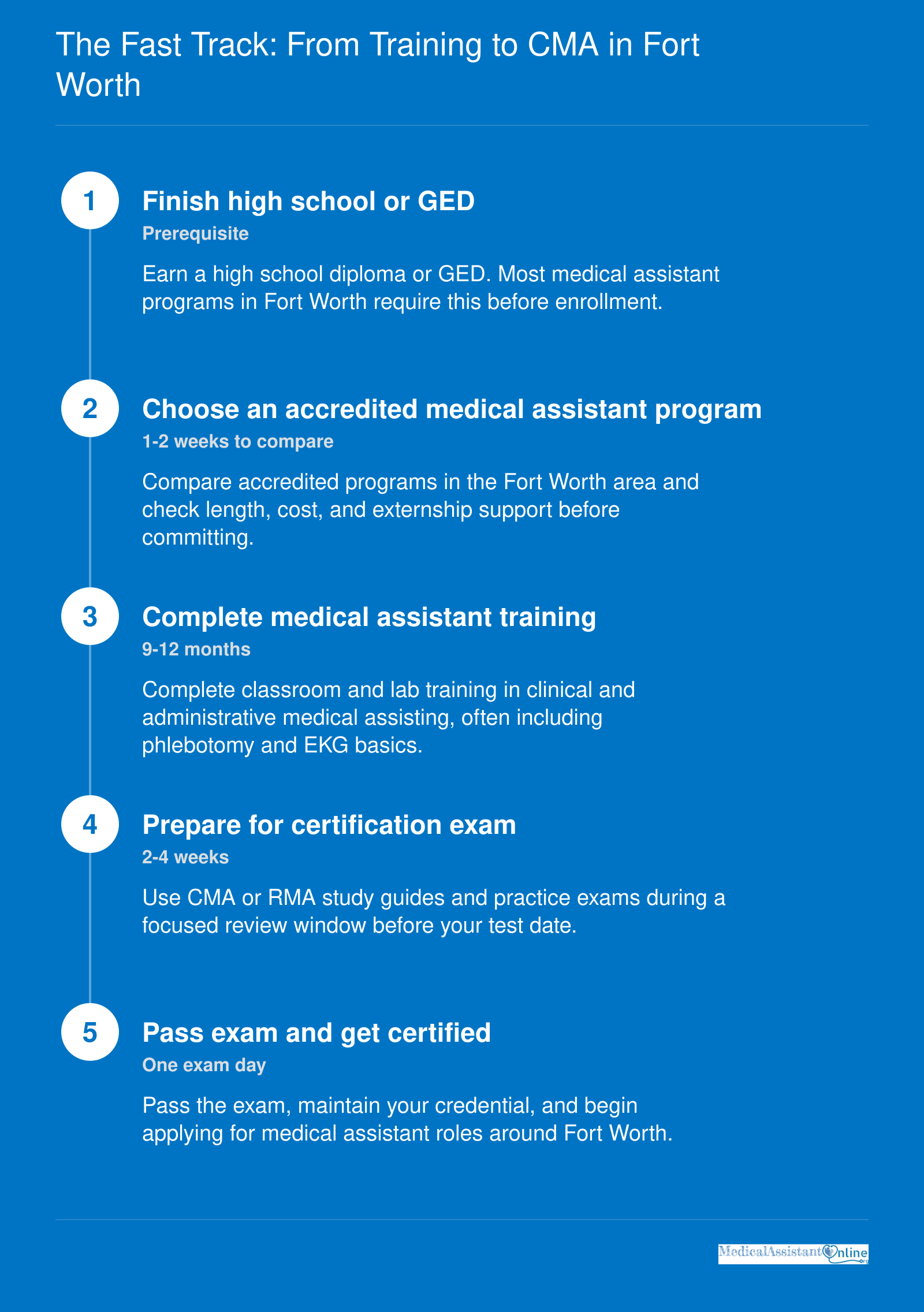
The Fast Track: From Training to CMA in Fort Worth
For most students, the path from high school completion to a Fort Worth medical assistant certification takes about 9 to 12 months of training plus a few weeks of exam preparation. This walkthrough shows the main milestones from classroom to credential.
Medical Assistant Salaries in Fort Worth: What BLS Data Shows
In the Dallas-Fort Worth-Arlington metro area, medical assistants earned a median annual wage of $40,160 as of the latest BLS data (2024). The 25th percentile was $36,300 and the 75th percentile was $46,460, which gives a typical entry level to experienced range. The metro employed about 21,110 medical assistants.
| Metric | Dallas-Fort Worth-Arlington, TX |
|---|---|
| Total employment | 21,110 |
| 25th percentile annual wage | $36,300 |
| Median annual wage | $40,160 |
| 75th percentile annual wage | $46,460 |
Clinical Externships and Fastest Program Timelines in Fort Worth
How many externship hours do Fort Worth medical assistant programs require, and how quickly can you finish the clinical portion? In this area, medical assistant externships generally range from 80 to 180 hours, and program lengths run from a fast 16-week certificate to a 36-week on-campus option.
Clinical hours: what to expect
Fort Worth Medical Assistant School requires an 80-hour externship in a local medical office or practice.1 The school offers advisor-assisted placement, meaning an academic advisor can help you identify opportunities and complete applications. Students may also find their own externship site if they already have a connection at a local clinic. One thing to confirm during enrollment is timing: school pages describe externship eligibility at different points, with one mentioning week 8 and another mentioning week 14, so the current start point may vary.
Stepful's Fort Worth Medical Assistant Program also requires an 80-hour externship, but it is completed after the online coursework. Stepful uses an externship booking platform to connect students with local clinical sites, and the program reports that interviews are typically secured within one to three months after the certification exam.
CHCP's on-campus Medical Assistant Certificate Program takes a longer clinical route with a 180-hour externship at a local healthcare facility.2 That extra time can give you more repetition with skills like rooming patients, taking vitals, and documenting in an EHR before you enter the job market.
Fastest program timelines in Fort Worth
- Stepful Fort Worth Medical Assistant Program: 16 weeks, or about four months, the fastest path among programs reviewed here.
- Fort Worth Medical Assistant School: 18 weeks, including the 80-hour externship.
- CHCP on-campus Medical Assistant Certificate Program: approximately 36 weeks, including the 180-hour externship.
How an externship can turn into a job
An externship is essentially a working interview. Clinic managers see how you handle patient flow, follow infection control rules, and communicate with the care team, and that exposure often leads to job interviews, references, or a direct offer. If a site cannot hire immediately, the supervisor can still write a reference that strengthens applications at nearby practices and health systems. Ask each school what placement support looks like, whether it assigns sites, helps with applications, or lets you find your own.
Medical Assistant Jobs and Top Employers in Fort Worth
Finding the right employer matters as much as completing your training. Fort Worth offers strong hiring demand across diverse healthcare settings, giving new medical assistants multiple pathways into the field.
Current Job Market Snapshot
Fort Worth's medical assistant job market remains active in 2026. LinkedIn currently lists approximately 975 medical assistant positions in the area, with Indeed showing 53 part-time roles specifically. This volume reflects consistent demand across urgent care centers, specialty clinics, hospital systems, and primary care practices throughout the Dallas-Fort Worth metro.
Hourly wages vary by employer and specialty. General medical assistant roles typically range from $22 to $24 per hour, while certified positions in specialty areas like oncology can reach $32.46 per hour or more. These figures align with the salary ranges covered earlier in this guide.
Major Healthcare Employers
Several large health systems anchor Fort Worth's medical assistant hiring:
- Texas Health Physicians Group: With over 250 locations and 800 providers across North Texas, this network regularly recruits medical assistants for clinic positions throughout the region.
- UT Southwestern Medical Center: Posted a Certified Medical Assistant role at their Fort Worth location on South Main Street in May 2026, indicating ongoing staffing needs.
- WellMed/Optum: Active in neighborhoods like Diamond Hill, with positions posted as recently as May 2026.
- Cook Children's Health Care System: A major pediatric employer offering specialized MA opportunities.
- JPS Health Network: The county's public hospital system serving Tarrant County with diverse clinical settings.
Beyond these systems, independent practices in dermatology, endocrinology, pulmonology, and primary care regularly hire throughout the metro area.
What Employers Seek
Most postings specify certification preferences, typically CMA or RMA credentials. Schedules vary from standard weekday clinic hours to part-time and extended-hours roles, offering flexibility for different career goals.
A Note on Placement Data
While employer demand is well documented through job postings, program-specific outcomes like job placement rates and certification pass rates are not publicly reported by most Fort Worth training programs. When researching schools, ask admissions representatives directly for these figures. The job market is strong, but verified outcome data helps you choose a program that delivers results.
Online Vs. On-Campus Medical Assistant Programs in Fort Worth
Fort Worth medical assistant programs are mostly hybrid, not fully online, because hands-on skills and clinical training still require in-person time. Tuition varies by school and format, and current program pages do not publish a simple online vs. on-campus price comparison, so contact admissions for exact costs. Use the schedule and time-to-completion differences below to match a program to your work hours and learning style.
| Factor | Online/Hybrid | On-Campus |
|---|---|---|
| Flexibility | CTK offers morning, day, and evening online classes with one weekly in-person clinical day. TSC offers daytime, evening, and weekend hybrid schedules. Fort Worth Medical Assistant School offers Saturday classes with online homework during the week. | CHCP Fort Worth requires regular weekday and Saturday campus attendance. Remington College offers morning or evening on-campus schedules plus required labs. CHCP online/hybrid students add Friday or Saturday lab sessions. |
| In-person requirement | CTK requires 1 clinical day per week. TSC requires 2 days per week, Monday and Wednesday. Fort Worth Medical Assistant School requires 4.5 hours of hands-on skills practice in person each Saturday. | CHCP on-campus students attend campus regularly for skills training. Remington hybrid students attend on-campus lab sessions. CHCP online/hybrid students attend required Friday or Saturday labs at a CHCP campus. |
| Hands-on training | Online and hybrid programs keep required in-person clinicals or labs. CTK includes one weekly clinical day, TSC includes twice-weekly in-person training, Fort Worth Medical Assistant School includes weekly Saturday practice, and CHCP online/hybrid includes scheduled lab sessions. | On-campus formats include structured clinical skills training. CHCP Fort Worth includes clinical skills and an externship, with 128 hours noted in the Texas program overview. Remington includes on-campus labs. CTK and TSC build hands-on hours into their required in-person days. |
| Networking | Hybrid students meet peers and instructors during weekly lab or clinical days at CTK, TSC, Fort Worth Medical Assistant School, and CHCP scheduled labs, but spend less time on campus than on-campus students. | On-campus students have more regular face-to-face time with instructors and classmates through CHCP Fort Worth campus hours Monday through Saturday and Remington morning or evening classes, which can make networking easier. |
| Time to completion | TSC is about 12 weeks. Fort Worth Medical Assistant School is 18 weeks. CTK is about 24 weeks. CHCP online/hybrid follows a blended schedule, and the standard CHCP medical assistant certificate timeframe is 36 weeks. | CHCP Fort Worth certificate is 36 weeks. Remington College diploma is about 9 months. CTK and TSC in-person or hybrid formats are shorter at about 24 and 12 weeks. |
Related Articles
Additional Medical Assistant Programs to Consider in Fort Worth
The harder call in Fort Worth is not whether you can find medical assistant programs in Texas, but how to balance program-level accreditation, schedule pressure, and training speed. These options sit outside the main table, so use them as a working list rather than a ranked order.
College-Based Options
- Tarrant County College (Fort Worth, Texas 76102): The CAAHEP-accredited certificate is delivered in person and totals 40 semester credit hours.1 This is the strongest choice here for students who want a college-credit pathway with a nationally recognized MA program accreditor.
- The College of Health Care Professions (Fort Worth, Texas 76137): This ABHES-accredited program uses a blended format and runs about 36 weeks.2 It fits students who want a structured mix of on-campus and online work without committing to a full college semester schedule.
Faster or More Flexible Formats
- Fort Worth Medical Assistant School (Fort Worth, Texas 76107): The 18-week training is state licensed by the Texas Workforce Commission, includes Saturday classes, and prepares students for the NHA CCMA exam.3 Note that this option does not list a separate institutional accreditor, so weigh that gap if program-level accreditation matters for your goals.
- Legacy Healthcare Careers (Richland Hills, Texas 76180): This 11-week, in-person program is approved by NCCT and combines classroom instruction with hands-on practice.4 It is one of the shortest options in the area, but like the school above, no separate school accreditor is readily identified.
- CTK Healthcare & Career Institute (Fort Worth area): The roughly six-month program blends online lectures with about one day per week of in-person clinicals. CTK is COE-accredited and also regulated by several Texas agencies, which adds a layer of oversight for a mostly online schedule.5
If Accreditation Is the Deciding Factor
For students who know they want both school accreditation and MA program accreditation, Tarrant County College is the clearest Fort Worth-area match. CHCP is a close second through ABHES, and CTK offers institutional accreditation through COE, though its MA program accreditation should be confirmed directly with the school. If you are willing to look slightly outside greater Fort Worth, Dallas College is another CAAHEP-aligned option, but it is in Dallas rather than the Fort Worth metro core.