Central Ohio's outpatient networks keep hiring, which makes medical assisting a practical entry point. The real tradeoff is cost against clinical access: a shorter, cheaper certificate can get you job-ready faster, but a program with stronger externship partnerships may open a job offer before you formally apply.
The metro's medical assistants earned a median $43,830 in 2024, with the middle half between $38,900 and $46,870. Accredited program tuition, length, and format vary sharply, so two students can pay very different prices for the same credential.
Ohio does not license medical assistants, yet most area employers strongly prefer CMA (AAMA) or CCMA certification. Accredited, exam-aligned training is the safer route.
Accredited Medical Assistant Schools in Columbus: Your Options
Columbus offers several CAAHEP- or ABHES-accredited medical assistant training options. The table below highlights programs with complete published details; Miami-Jacobs Career College's Columbus campus is CAAHEP-accredited but did not have current program length, credential, and format information available at publication. If you are willing to commute, Cincinnati State Technical and Community College is also listed as a nearby CAAHEP-accredited option.
| School | Program Length | Credential | Accreditation | Format |
|---|---|---|---|---|
| Columbus State Community College | Three semesters | Certificate in Medical Assisting | Commission on Accreditation of Allied Health Education Programs (CAAHEP) | In-person with unpaid externship (210 clock hours) |
| Eastland-Fairfield Career and Technical Schools | 9 months | Certificate in Medical Assisting | Commission on Accreditation of Allied Health Education Programs (CAAHEP) | N/A |
| Hondros College of Nursing | As few as 12 months | Diploma in Medical Assisting | Accrediting Bureau of Health Education Schools (ABHES) | Hybrid (online coursework plus in-person training) |
| Cincinnati State Technical and Community College | Three semesters | Short-Term Medical Assisting Certificate | Commission on Accreditation of Allied Health Education Programs (CAAHEP) | N/A |
What You'll Pay: Medical Assistant Program Tuition and Financial Aid in Columbus
Published tuition varies widely by program type and length. The figures below reflect the most recent posted prices, but students should confirm final costs and aid eligibility directly with each school.
| School | Tuition Range | Fees | Financial Aid Options |
|---|---|---|---|
| Columbus State Community College, Medical Assisting A.A.S./Certificate | $172.43 per credit tuition plus $20.50 general fee for Ohio residents, totaling $192.93 per credit; about $6,088 for 30 credits | $20.50 per credit general fee | Federal grants and loans, institutional scholarships, and estimated financial aid tied to registration; apply through the college financial aid office |
| Columbus Medical Assistant School, Columbus campus | $3,490 if paid before the program starts | $300 payment plan fee if using the Pay as You Go option, for a total of $3,790 | No federal or traditional college financial aid accepted; the school states it does not accept financial aid |
| Hondros College of Nursing, Medical Assistant program, Columbus | $18,847 estimated program tuition | Not listed | Federal grants and loans may be available through Hondros College of Nursing (Title IV participant); specific medical assistant program aid details are not listed |
| Ohio University Regional Campus, health-related programs, Columbus area option | $3,276 per semester and $6,552 annually for in state students; out of state students have an additional tuition and fee surcharge | $1,618 per semester out of state surcharge, $3,236 annually; total annual cost of attendance is $17,684 in state and $20,920 out of state | Federal aid programs and institutional scholarships are available; medical assistant program specific awards are not listed |
Core Curriculum in Columbus Medical Assistant Programs
Columbus medical assistant programs teach the same foundation you will actually use on day one of a clinical or administrative job, and they structure it to line up with national CMA (AAMA) and CCMA exam blueprints.
Clinical and Administrative Foundations
Programs in Columbus typically start with medical terminology and anatomy and physiology, then layer in clinical medical assistant skills such as vital signs, infection control, phlebotomy, electrocardiography, and basic lab procedures. On the administrative medical assistant side, students practice scheduling, insurance verification, patient intake, medical billing, and electronic health record (EHR) workflow.
- Medical terminology and body systems: Builds the vocabulary for charting and patient communication.
- Clinical procedures: Vital signs, injections, EKG, phlebotomy, specimen collection, and infection control.
- Administrative skills: Scheduling, billing, coding basics, and front-office workflow.
Columbus employers expect new medical assistants to move between front-office and back-office duties, so curricula mirror that mix rather than teaching the two tracks in isolation.
Exam-Aligned Content
Because local programs align their objectives with CMA (AAMA) and CCMA content areas, the coursework doubles as CMA exam prep. Instructors test you on the same categories you will see on certification day: clinical patient care, medical law and ethics, communication, and office management.
From Classroom to Externship
The classroom piece is intentionally sequenced so that medical assistant externship feels like practice, not the first time. You learn a skill, practice it in lab, and then apply it during supervised clinical hours at a Columbus-area clinic, physician office, or hospital outpatient setting. EHR simulation is especially useful: by the time you use the live system at a site, you are not fumbling through patient charts. Many Columbus programs also build in a short certification review module before the externship ends, so students can sit for the CMA (AAMA) or CCMA shortly after graduation.
Externship Hours and Clinical Partner Sites at Columbus Programs
Externship hour requirements vary by Columbus program, from 40 hours up to 210 hours. These supervised clinical rotations let students practice back-office and patient-care skills in real medical settings, and they help build the hands-on experience often expected for CMA or RMA certification eligibility. Program-specific details are listed below.
| School | Externship Hours | Clinical Partner Examples |
|---|---|---|
| Columbus State Community College: Medical Assisting Program | 210 hours (unpaid) | No specific partner sites named. |
| Columbus Medical Assistant School: Medical Assistant Program | 80 hours | Local medical offices in Columbus; students are encouraged to find their own externship sites, with support from Student Success Specialists who identify potential opportunities in the area. |
| Ohio School of Phlebotomy: Clinical Medical Assisting Program | 40 to 120 hours | Clinical patient care settings chosen by hosting facilities; specific partner facility names are not listed. |
| Hondros College of Nursing: Medical Assisting Program | 180 hours | Externship completed onsite at a facility of a Hondros College of Nursing healthcare partner; specific partner facility names are not listed. |
| Stepful: Ohio Medical Assistant Certification Program | N/A | Local organizations in Ohio that may host externships include OhioHealth, Cleveland Clinic, and Wexner Medical Center; placements are arranged near the student location in Ohio. |
| CapYear Academy: Clinical Medical Assistant Training | 90 hours (optional) | N/A |
What Do Medical Assistants Earn in Columbus?
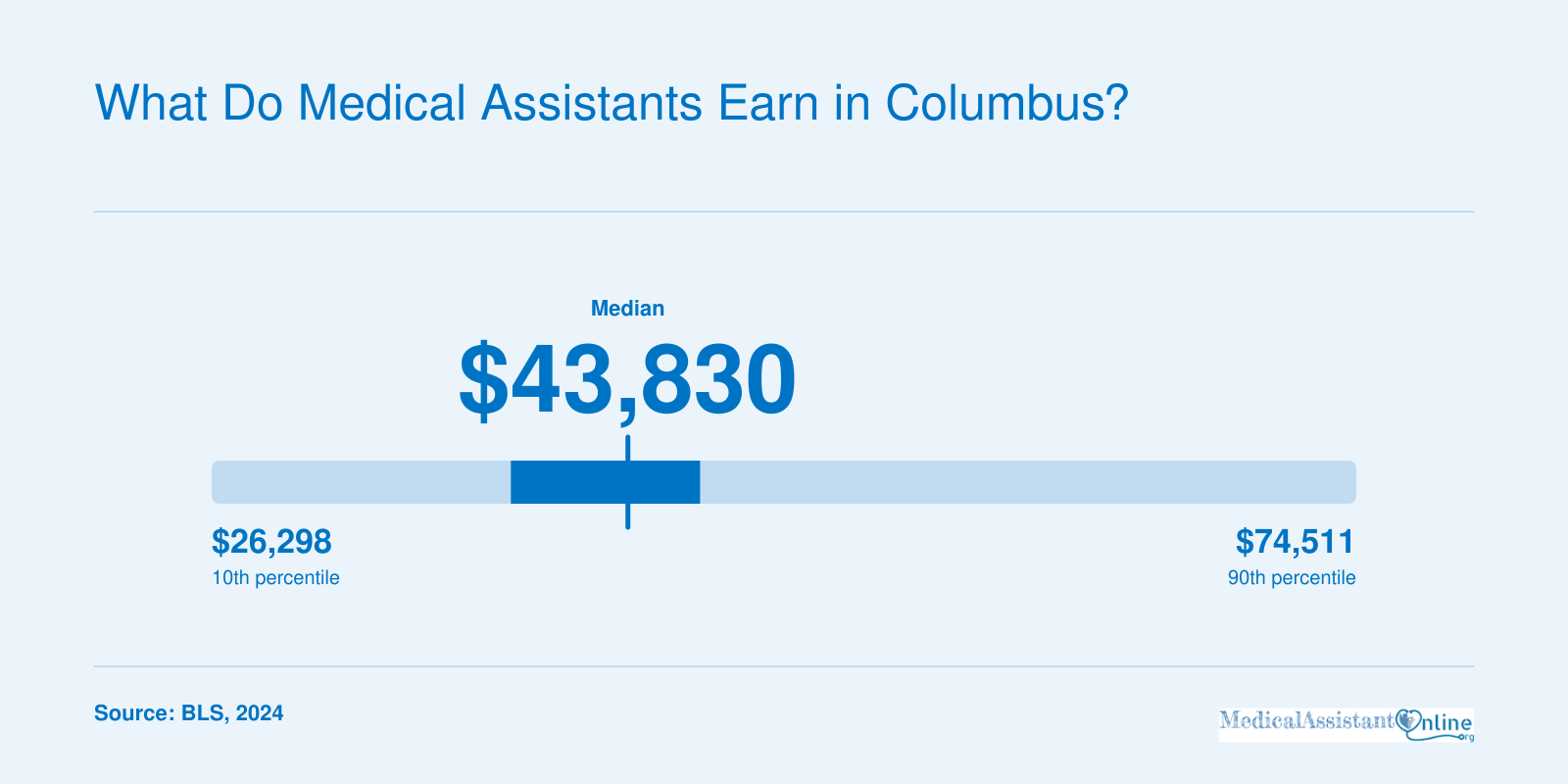
In the Columbus metro area, medical assistants earned a median annual wage of $43,830 in 2024, according to the U.S. Bureau of Labor Statistics. The middle half of earners made between $38,900 and $46,870, which is the typical pay range for both new and experienced medical assistants.
Related Articles
Medical Assistant Jobs and Employers in Columbus: Where You'll Work
Healthcare hiring in Columbus continues to outpace many other metro areas, driven by expanding outpatient networks and an aging population requiring more clinical support. For medical assistants completing accredited programs in the region, this translates into steady demand across a wide range of settings.
Major Health Systems Hiring Medical Assistants
Columbus anchors one of the largest healthcare markets in the Midwest, and four major employers dominate MA hiring:
- OhioHealth: Operates Riverside Methodist, Grant Medical Center, and dozens of physician practices throughout Franklin County. OhioHealth regularly posts entry-level MA openings in primary care, cardiology, and urgent care, where a polished Medical Assistant Resume Guide can help applicants stand out.
- Mount Carmel Health System: Part of Trinity Health, Mount Carmel runs hospitals in Grove City, Westerville, and downtown Columbus, plus specialty clinics that employ MAs in orthopedics, gastroenterology, and women's health.
- Nationwide Children's Hospital: One of the nation's largest pediatric hospitals, Nationwide Children's hires medical assistants for outpatient specialty clinics, same-day surgery centers, and primary care satellites across central Ohio.
- Ohio State Wexner Medical Center: The academic medical center affiliated with Ohio State University employs MAs in more than 50 specialty and primary care practices, offering exposure to research-driven care environments.
Common Work Settings
Most Columbus MAs work in outpatient environments rather than inpatient hospitals. Typical settings include:
- Physician offices (family medicine, internal medicine, pediatrics)
- Outpatient specialty clinics (dermatology, cardiology, oncology)
- Urgent care and retail health clinics
- Hospital-based ambulatory surgery centers
How Training Connects to Employer Demand
Local medical assistant schools structure externships to place students inside these very health systems, meaning clinical rotations often double as extended job interviews. Employers tell program directors exactly which competencies they need, from electronic health records proficiency to phlebotomy accuracy, so curriculum stays aligned with hiring expectations. Graduates who complete externships at OhioHealth or Mount Carmel sites frequently receive job offers before their final semester ends.
Ohio Medical Assisting Credentialing: What You Need to Know
Admissions Prerequisites, Deadlines, and Enrollment Steps
Requirements vary by school, so confirm the exact checklist with any program you’re considering. Here’s what to expect at Columbus-area medical assistant programs in 2026.
- High school diploma or GEDEvery Columbus program reviewed requires a high school diploma or GED. Columbus State asks for a final official high school transcript or GED scores (minimum average 45, no section below 35), plus any college transcripts.
- Age and health requirementsMany programs, including Ohio School of Phlebotomy and Chance Medical Academy, require you to be at least 18. Clinical requirements often include current CPR/AED and First Aid cards, immunizations, a health screening, and sometimes a TB test or health insurance, confirm with your program.
- Background check and drug screeningExpect a background check and drug screening at many programs. Columbus State runs these when the coordinator determines they’re needed, while Herzing lists drug testing, immunizations, and a background check as standard clinical requirements.
- Application and transcriptsApply online to the school first, then submit your application packet. Columbus State also requires a mandatory info session or online PowerPoint with a quiz. Herzing uses an admissions interview and application.
- Placement testing or prerequisitesColumbus State places you into MATH 1104 or STAT 1350 and ENGLISH 1100, and requires a C or better in all required courses with a minimum 2.0 GPA. Herzing accepts ACT/SAT scores, prior college credit, or an entrance test.
- Enrollment deadlines and start datesDeadlines vary. Columbus State’s deadline is July 31 for autumn entry; other Columbus programs often use rolling or informal admissions. Contact each school to confirm start dates and cutoffs for 2026.
National Medical Assistant Salary: How Columbus Compares
For context, here is the national benchmark for medical assistant pay.
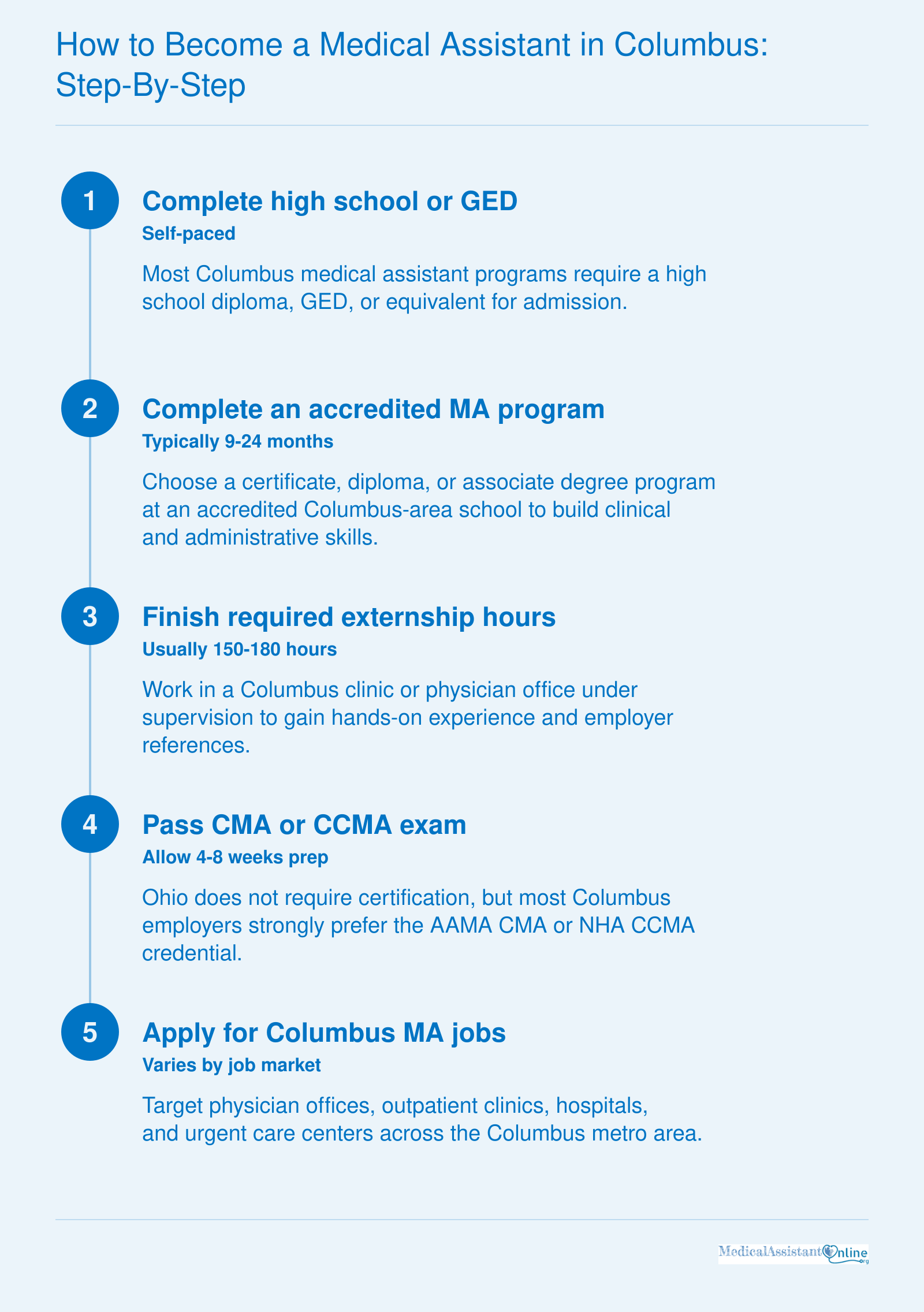
How to Become a Medical Assistant in Columbus: Step-By-Step
In Columbus, medical assistants typically follow five main steps from first credential to job search. Certification is voluntary in Ohio, but most local employers strongly prefer it.
Job Placement Rates, Employer Partnerships, and Graduate Outcomes
Choosing a medical assistant program means balancing cost and time against how well the school actually helps graduates land jobs. Published outcome data vary widely among Columbus-area schools, so knowing where to find reliable numbers helps you compare apples to apples.
Columbus State Community College: Transparent Outcomes
Columbus State publishes detailed graduate outcomes based on MAERB (Medical Assisting Education Review Board) reporting standards. Their placement rates have been consistently strong:
- 2024: 93.10% placement rate
- 2023: 97.78% placement rate
- 2022: 86.57% placement rate
- 2021: 84.62% placement rate
- Five-year average: 90.63%1
Placement here means graduates are working as medical assistants, employed in a related healthcare field, continuing education in allied health, or serving in the military. The college does not guarantee job placement, but these numbers reflect real tracking.
CMA exam pass rates at Columbus State have ranged from 71% to 88% over recent years, with a five-year average of 79.38%1. While not as high as placement figures, this gives you a realistic picture of how well the program prepares students for credentialing exams.
Athena Career Academy: Placement Support Without Guarantees
Athena Career Academy reported that 75% of its 2017-2018 graduates were confirmed employed as medical assistants2. The school verifies placement through graduate interviews, written employer confirmation, or third-party documentation. Like most programs, Athena provides job search assistance but does not guarantee employment or a specific medical assistant salary.
Fortis College: Career Services Focus
Fortis College in Columbus-Westerville emphasizes individualized career services support, working with each student on job search strategies. However, the school does not publicly report numeric placement rates or certification pass rates, so prospective students should ask admissions directly for outcome data.
When Data Is Not Available
Several Columbus-area programs do not publish detailed graduate outcomes on their websites. If a school you are considering does not share placement or certification pass rates, request this information during your campus visit or admissions call. Accredited programs track these numbers for accreditation purposes, even if they do not post them publicly.
Strong graduate outcomes reflect program quality and employer relationships. When comparing schools, prioritize those willing to share concrete data over vague promises of career support.
Frequently Asked Questions About Columbus Medical Assisting
Medical assistants are in demand in the Columbus metro, earning a median annual wage of roughly $40,000, and the role remains one of the fastest entry-level paths into outpatient care. That puts Columbus slightly below the national median, but the area's lower training cost and steady clinic demand make it a practical option.
Training and Certification
Most Columbus diploma and certificate programs take 9 to 12 months of full-time study, with part-time tracks often running 12 to 18 months. Associate degree programs at community colleges typically run 18 to 24 months because they add general education courses. If you already hold college credit, some core requirements may transfer and shorten the timeline.
Ohio does not require a separate state license to become a medical assistant, but Columbus clinics, hospitals, and staffing agencies often prefer or require a national credential. Earning the CMA or CCMA before you begin applying, or within your first few months on the job, is the strongest route to higher pay and clinical roles.
Salary and Online Options
Columbus-area medical assistants typically earn around $40,000 per year, with most full-time hourly wages in the $18 to $21 range. Entry-level positions often start closer to $35,000, while experienced assistants in specialty clinics or lead roles can earn above $45,000. Paid time off, health benefits, and tuition reimbursement add to the full package.
Yes, several Ohio schools offer hybrid online medical assistant training. You complete lectures, anatomy, and medical terminology online, then attend on-campus lab sessions in or near Columbus for hands-on skills. A local clinical externship is still required. Fully online programs are rare because blood draws, EKGs, and injections need in-person evaluation.
Externships and Credentials
The CMA credential is awarded by the American Association of Medical Assistants after passing the CMA exam. The CCMA is awarded by the National Healthcareer Association after the CCMA exam. Columbus employers accept both, so your best choice usually follows the exam prep included in your program and the paperwork local clinics list in their job posts.
Most accredited Columbus and central Ohio programs, including Columbus State Community College and several private career colleges, include a supervised clinical externship. Expect roughly 160 to 240 hours in a physician office, urgent care center, or hospital outpatient clinic. Before enrolling, ask whether the school assigns your site or expects you to secure placement.