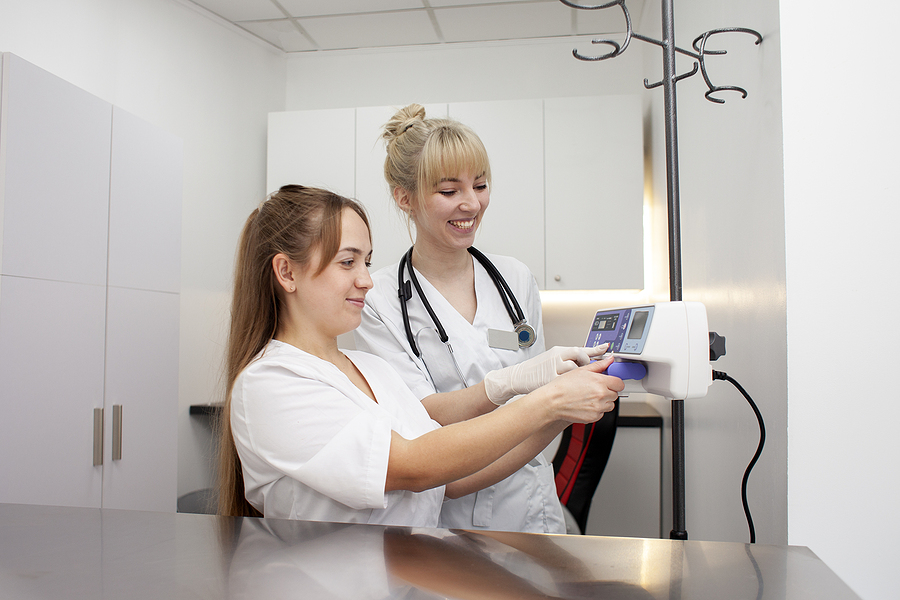
Some medical assistant jobs split the day between front-desk check-in and clinical support; clinical medical assistants lean almost entirely into hands-on tasks like phlebotomy, EKGs, and exam-room setup. That difference shapes pay, certification choices, and where you can work.
National estimates now count about 793,000 medical assistant jobs, with a median annual medical assistant salary near $44,200. Training often runs less than a year, and community college programs can start under $3,000, though private school pricing reaches $20,000 or more.
Certification names and state scope-of-practice rules vary enough that two people with identical training may have different daily duties. The job you actually get depends on matching a credential like the CCMA to your state's rules and the employers near you.
Clinical Medical Assistant Vs. General Medical Assistant: Understanding the Role
Clinical and general medical assistants share the same broad occupation, but the daily mix of work can look very different. A clinical medical assistant is the hands-on patient care version of the role, while a general medical assistant often divides time between the front office and the exam room.
| Dimension | Clinical Medical Assistant | General Medical Assistant |
|---|---|---|
| Primary focus | Hands-on patient care: recording vital signs, assisting with exams, and supporting clinical procedures. | A mix of administrative and clinical duties, with billing, scheduling, and records often taking a larger share of the day. |
| Core daily tasks | Vital signs, phlebotomy, EKG setup, injections, and exam room preparation. | Answering phones, managing records, scheduling appointments, insurance verification, and front office tasks. |
| Common work settings | Outpatient clinics, urgent care centers, and hospital outpatient departments focused on direct patient flow. | Multi-specialty practices and office-based settings where front office and back office duties are blended. |
| Pay signal | Average $17.78 per hour, or $36,990 annually, reported as about 3% higher than administrative medical assistant pay. | Administrative medical assistant pay averages about 3% below clinical-focused roles; national median for all medical assistants is $21.25 per hour, or $44,200 per year. |
| Hiring and documented skills | Clinical skills such as phlebotomy, EKG, and injections are often explicitly documented and preferred for hands-on patient care roles. | Employers hiring blended roles may look for scheduling, billing, electronic health record, and basic clinical competencies. |
Clinical Medical Assistant Duties and Work Settings
The appeal of clinical medical assisting is the hands-on patient care, but the exact tasks you perform on any given shift are shaped by your state's medical assistant scope of practice rules and your employer's policies. In most settings, you work under the supervision of a physician, nurse practitioner, or physician assistant, and that oversight keeps clinical duties within safe, legal limits.
Core Clinical Duties
- Patient intake: You room patients, verify the reason for the visit, and record a focused medical history.
- Vital signs and measurements: You take temperature, pulse, respiration, blood pressure, height, weight, and oxygen saturation, then chart the results.
- Specimen collection and testing: You may draw blood, collect urine or throat swabs, and run waived point-of-care tests.
- Cardiac testing: You perform electrocardiograms (EKGs) and prepare the tracing for provider review.
- Medication administration: Where state law and employer policy allow, you give injections such as vaccines or routine medications under a provider's order.
- Exam and procedure support: You set up sterile trays, hand instruments to the provider, assist with minor procedures, and clean and restock exam rooms after each visit.
Work Settings and Variations
Clinical medical assistants work in primary care clinics, specialty practices such as cardiology or dermatology, urgent care centers, and hospital outpatient departments. In primary care, the day tends to be broad and steady. Cardiology medical assistants may spend more time on EKGs, medication reconciliation, and patient education. Dermatology medical assistants often focus on wound care, suture removal, and preparing for skin procedures. Urgent care can be faster paced, with more point-of-care testing and less predictable patient flow.
A Typical Morning in Primary Care
Your first patient arrives for a follow-up visit. You room her, take her blood pressure, ask about new symptoms, and update her medications. The provider asks you to administer a flu vaccine and draw routine labs before the next patient is roomed. By mid-morning, you have completed an EKG, assisted with a minor wound repair, and returned two patient phone messages. Each task is familiar, but the mix changes by the hour and by the practice.
How to Become a Clinical Medical Assistant: Step-By-Step Education and Certification
Most clinical medical assistant positions require just four concrete steps between where you are now and your first day on the job. The process is straightforward, but each step builds on the last, so understanding the full path helps you make smarter decisions early on.
Step 1: Earn a High School Diploma or GED
A diploma or equivalent is the baseline requirement for virtually every accredited training program. If you are still in high school, focus on biology, health sciences, and basic math. These courses will give you a head start once formal training begins.
Step 2: Complete an Accredited Training Program
You have two main options here. Certificate or diploma programs typically run 9 to 12 months and concentrate on clinical skills, medical terminology, anatomy, and pharmacology. Associate degree programs take up to two years and add general education courses that can strengthen your resume or serve as a stepping stone toward a nursing or health administration degree later.
Whichever path you choose, look for programs accredited by CAAHEP or ABHES. Accreditation matters because many certification exams require graduation from an accredited program, and employers view it as a quality signal.
Step 3: Complete Hands-On Clinical Experience
Choose a program that includes an externship component. Externships place you in a real medical office, clinic, or hospital setting where you practice skills like phlebotomy, injections, EKGs, and patient intake under supervision. Programs without this component leave a gap that makes it harder to land your first job. We cover externship requirements and placement strategies in a later section.
Step 4: Pass a Certification Exam
Certification is not legally required in every state, but it is strongly preferred by employers and often translates into higher starting pay. The most common credential for clinically focused medical assistants is the Certified Clinical Medical Assistant (CCMA) through NHA, though CMA and RMA credentials also qualify you for clinical roles. We compare these options in the certification section that follows.
Step 5: Apply for Jobs
With your training, externship experience, and certification in hand, you are ready to start applying. Many graduates find that externship sites offer them positions directly, which is another reason choosing the right program matters from the start.
CCMA, CMA, and RMA: Choosing and Maintaining Your Clinical Medical Assistant Certification
Choosing between the CCMA, CMA (AAMA), and RMA often comes down to your local employers' preferences and the type of medical assisting you want to do. The CCMA from the National Healthcareer Association is especially common for clinical-heavy roles, while the CMA (AAMA) and RMA (AMT) are also widely recognized. Because all three require documented continuing education to stay active, compare the renewal cycles, fees, and CEU totals below before you commit.
| Credential Detail | CCMA (NHA) | CMA (AAMA) | RMA (AMT) |
|---|---|---|---|
| Issuing body | National Healthcareer Association (NHA) | American Association of Medical Assistants (AAMA) | American Medical Technologists (AMT) |
| Renewal period | Every 2 years | Every 60 months (5 years) | Annual renewal |
| CEU requirements | 10 continuing education credits per 2-year cycle | 60 continuing education units per 5-year cycle | 16 continuing education points per 3-year period |
| Renewal fee | $195 every two years | $80 for AAMA members; $160 for nonmembers | Annual renewal fee required; exact amount not published |
How Long Does Clinical Medical Assistant Training Take and What Does It Cost?
Clinical medical assistant training is one of the fastest routes into hands-on patient care, but the price can swing from under $3,000 at a community college to more than $20,000 at a private school depending on the credential and what is bundled into tuition.
Typical program lengths
Most clinical medical assistant certificate and diploma programs take 9 to 12 months of full-time study. A medical assistant associate's degree usually runs 18 to 24 months because it layers general education requirements onto the clinical and administrative coursework. Part-time and fully online tracks can stretch either option, so confirm the published completion time matches your schedule.
What training actually costs
Community college certificate programs commonly fall between roughly $1,500 and $10,000, with many clinical medical assistant certificates landing in the $2,500 to $7,500 range. For example, Community College of Philadelphia lists the in-person program at about $2,964, with a separate $165 exam fee, while its asynchronous online version is closer to $2,599.1 Private career schools are higher, often $10,000 to $20,000 or more,3 and private school associate degrees can climb into the $30,000s.
The sticker price is not the whole story. Some totals include books, supplies, background checks, drug testing, and the certification exam. Others leave those out. Before enrolling, ask for a written breakdown of tuition, fees, books, uniforms, and exam costs so you are comparing true totals.
Financial aid and cost reduction
- Federal aid: Pell Grants and federal student loans may be available through the FAFSA for eligible programs.
- Scholarships: Professional associations such as the AAMA offer scholarships; ask the financial aid office about local awards too.
- Employer reimbursement: Many healthcare employers reimburse tuition for medical assistant training, especially if you commit to work after certification.
- State and workforce programs: Some state programs reduce costs sharply. Danville Community College's program, for instance, can drop from $3,267 to about $1,089 for eligible Virginia residents through the FastForward program, and some workforce programs cover 100% of tuition.24
Check the clinical-hour value
When comparing programs, divide the total all-in cost by the supervised clinical hours included. A cheap program with no medical assistant externship may leave you without the experience employers expect, while a higher-cost program that bundles an externship and exam fee may be the better value.
Clinical Medical Assistant Salary and Job Outlook
Medical assistants held about 793,460 jobs in the latest national estimates. The median annual wage was $44,200, with the middle half of earners between $37,610 and $48,160. Clinical medical assistants with specialized skills often earn toward the upper end or above, and state-level salary details are covered next.
| Measure | National estimate |
|---|---|
| Total employment | 793,460 |
| Mean annual wage | $44,720 |
| 25th percentile annual wage | $37,610 |
| Median annual wage | $44,200 |
| 75th percentile annual wage | $48,160 |
| Projected job growth, 2024 to 2034 | 12 percent |
| Projected annual job openings, 2024 to 2034 | 112,300 |
Clinical Medical Assistant Salary by State
Median pay varies widely by state. Washington, Alaska, Oregon, the District of Columbia, and Minnesota lead the states shown here at $55,120, $51,860, $49,900, $49,740, and $49,380 respectively. At the lower end, Vermont, Maryland, Iowa, Nevada, and Idaho report medians of $45,330, $45,060, $43,670, $43,450, and $43,400. Keep in mind that these figures do not adjust for local cost of living, so compare them with current job postings in your area.
| State | Median Annual Salary |
|---|---|
| Washington | 55120 |
| Alaska | 51860 |
| Oregon | 49900 |
| District of Columbia | 49740 |
| Minnesota | 49380 |
| Hawaii | 48820 |
| Massachusetts | 48540 |
| California | 48050 |
| New Hampshire | 48040 |
| Wisconsin | 47610 |
| Colorado | 47270 |
| Maine | 46540 |
| Connecticut | 46500 |
| New Jersey | 46280 |
| Nebraska | 46080 |
| New York | 46040 |
| Rhode Island | 45820 |
| Illinois | 45490 |
| Montana | 45440 |
| Arizona | 45440 |
| Vermont | 45330 |
| Maryland | 45060 |
| Iowa | 43670 |
| Nevada | 43450 |
| Idaho | 43400 |
Related Articles
State-By-State Scope of Practice for Clinical Medical Assistants
Some states spell out exactly which clinical tasks fall within the evolving role of medical assistants, while others rely on broad delegation language that leaves the details to the supervising physician. This patchwork means two clinical medical assistants with identical training could have noticeably different day-to-day responsibilities depending on where they work.
The Delegation Framework Most States Follow
Rather than granting medical assistants an independent license, the vast majority of states use a delegation model. A physician or other authorized practitioner may delegate clinical tasks to an MA only when:
- The task falls within the delegating provider's own scope of practice.
- The MA has been trained and deemed competent to perform it.
- The level of supervision the state requires is maintained.
Because each state defines "supervision" differently, ranging from general oversight to direct visual observation, the practical effect on your duties can vary widely.
States With Notable Requirements
A handful of states stand out for imposing specific credentialing or supervision rules that clinical medical assistants need to know.
- Washington: Requires formal Medical Assistant Certification or registration. MAs may give injections, administer medications, draw blood, and perform EKGs, but IV procedures require direct visual supervision and certain medication routes demand immediate supervision.1
- Montana: Permits injections, IV medications, invasive procedures, and allergy testing, but requires onsite or direct supervision for all of those tasks except immunizations, which may fall under general supervision.2
- California: Allows IM, intradermal, and subcutaneous injections with documented training and verification by a licensed provider. Phlebotomy requires a separate credential.
- New Jersey: Permits injections and phlebotomy only when the MA holds one of several specified credentials recognized by the state.
States Without Formal MA Regulation
Many states have no standalone medical assistant practice act. In those jurisdictions, the supervising provider's judgment, combined with any employer policies and facility protocols, effectively sets the boundaries. This does not mean anything goes; it means the rules live in broader medical practice statutes rather than MA-specific law.
How to Verify Your State's Rules
Before you start a new position or relocate, check two sources: your state medical board's website and the AAMA's state-by-state scope of practice chart, which is updated periodically. Washington's Department of Health FAQ and the Medical Board of California's MA FAQ are good examples of state-level resources that outline permitted tasks in plain language. Confirming your scope before your first day protects both you and your patients.
Externships and Clinical Hours: Supervised Experience Requirements and Placement Tips
An externship is the supervised, hands-on training period at the end of most clinical medical assistant programs, an important step in how to become a medical assistant, where you apply classroom skills in a real healthcare setting, typically without pay. Think of it as a working interview: you will take patient vitals, assist with procedures, and document encounters while a preceptor evaluates your readiness for the job.
How Many Hours You Will Need
Most accredited programs require between 160 and 240 clinical hours, though the exact number depends on your school and the certification you plan to pursue. CAAHEP and ABHES accredited programs generally set 160 hours as the floor.1 Some schools ask for more: San Jacinto College requires 240 hours2, Grays Harbor College expects 180 hours3, and certain programs split time between administrative medical assistant tasks and clinical rotations (Trocaire College divides its 160 hours into 80 administrative and 80 clinical4). A handful of continuing education courses require fewer hours, around 965, so always confirm your program's requirements before enrolling.
How Placement Works
Schools typically arrange externship sites for students, often partnering with local clinics, physician offices, or outpatient centers. Some programs allow or require you to find your own placement, especially in online or hybrid formats. If you are responsible for securing a site, start early, since clinics fill student spots quickly and need time to process background checks and paperwork.
Getting the Most From Your Externship
During your rotation, expect supervised patient interactions, documentation practice in the EHR, and formal performance evaluations. Treat every shift like a job interview: arrive early, ask questions, and request feedback from your preceptor. Strong impressions often lead directly to medical assistant jobs.
Why Documentation Matters
Keep copies of your completed hours log and any competency checklists your preceptor signs off on. Many employers ask for proof of clinical experience before extending an offer, and certification bodies may require verification if you apply through an alternate pathway.
What Employers Look For: Clinical Medical Assistant Certification Preferences and Hiring Requirements
Clinical medical assistant hiring varies by employer, but these are the credentials and experiences most often requested in 2025–2026 job postings.
- EducationHigh school diploma or GED plus completion of an accredited medical assistant program is standard; some employers accept phlebotomy, CNA, or equivalent experience.
- CPR/BLSCurrent CPR or BLS certification is routinely required, sometimes allowing up to 30 days after hire.
- National certificationEmployers commonly accept CCMA, CMA, or RMA. There is no clear single dominant credential, but some prefer AAMA (CMA) for first consideration, and larger health systems may require national certification as a condition of employment or within six months.
- Experience and skillsMany postings ask for 1–2 years of clinical experience, plus phlebotomy, EKG, and EMR experience. Entry-level roles often accept certification in place of experience.
- Other preferencesA completed clinical externship is frequently expected, and bilingual Spanish skills can be an advantage.
Finding Your First Clinical Medical Assistant Job: Resume and Search Strategies
How do you land your first clinical medical assistant position when most job postings ask for experience you haven't had a chance to build yet?
The short answer: a targeted resume, a smart job search strategy, and solid interview preparation can close that gap faster than you might expect.
Build a Resume That Highlights Clinical Competence
Hiring managers scanning clinical MA resumes want to see hands-on skills right away. Place your certification (CCMA, CMA, or RMA) near the top, followed by a concise skills section listing competencies like venipuncture, EKG administration, injections, vital signs, and specimen collection. If your externship gave you measurable experience, quantify it: "Assisted with intake for 25 to 30 patients per day in a multi-provider family practice" tells a manager far more than a vague description.
Devote a full section to your externship. Include the site name, setting type, supervising provider, and total clinical hours completed. Treat it as professional experience, not just coursework.
Target the Right Employers
- Specialty clinics and urgent care centers: These settings rely heavily on clinical skills and are often more willing to hire newly certified MAs.
- Medical staffing agencies: Temporary placements let you build experience quickly and can convert into permanent roles.
- Externship connections: Many clinical sites hire their own externs, so treat every externship shift like a working interview.
Prepare for Interviews With Purpose
Review common clinical scenarios you may be asked about, such as handling an abnormal vital sign reading or responding to a patient experiencing a vasovagal reaction during a blood draw. Brush up on your state's scope of practice rules so you can confidently explain what you can and cannot do under physician supervision.
Do Not Wait for the "Perfect" Posting
If a listing asks for one to two years of experience but you hold a current certification and completed a strong externship, apply anyway. Many employers value a credentialed candidate who demonstrates clinical readiness over someone with more time but no certification. Your credential signals that you have met a national competency standard, and that carries real weight in hiring decisions.