

How fast can you actually earn an online medical assistant certificate in 2025? For most accredited programs, the honest answer is four to six months of focused coursework plus a supervised externship of roughly 160 clinical hours. A handful of self-paced options compress the didactic portion into eight to twelve weeks.
The tension is real: employers and certifying bodies like the NHA (for the CCMA) still expect hands-on clinical competency, which caps how much of the training can live entirely online. Programs that skip the externship rarely qualify graduates to sit for the major national exams.
Top 6 Fast Online Medical Assistant Certificate Programs in 2026
These six online and hybrid medical assistant certificates stand out for their short completion timelines and hands-on clinical components. The fastest option is a fully online self-paced course, while the accredited programs balance speed with required skills labs or practicums. All six can get you exam-ready in roughly a year or less.
Emory University
#1Atlanta, GA · $23,000/yr
Best for: Self-paced learners needing online flexibility
Emory University offers a fully online, self-paced Clinical Medical Assistant certificate that can be completed in as little as four to six months. The non-credit program prepares students for the NHA CCMA and NWCA CMAC exams, with job placement and externship placement support available. It is not CAAHEP or ABHES accredited, which matters for CMA (AAMA) eligibility.
- 4-6 month self-paced online format
- Prepares for NHA CCMA and NWCA CMAC exams
- Non-credit program; no standard financial aid
- Fully online with 24/7 learner support
- Externship and job placement support available
- Not CAAHEP/ABHES accredited
Cabarrus College of Health Sciences
#2Concord, NC · $15,000 – $20,000/yr
Best for: Hands-on learners wanting hybrid schedule
Cabarrus College of Health Sciences offers a medical assisting pathway with both a fast 11-month diploma and a two-year associate degree. The diploma option blends online learning with weekly hands-on clinical experience, and the program is accredited by CAAHEP. Students benefit from an affiliation with Atrium Health, including a forgivable loan up to $5,000 for diploma students who commit to work there after graduation.
- 11-month diploma or two-year associate degree
- Hybrid online and on-campus format
- Weekly hands-on clinical experience
- CAAHEP accredited
- Atrium Health affiliation with forgivable loan up to $5,000
- Rolling admissions with priority deadlines
- Tuition and fees $15,111 for diploma
Mercy College of Health Sciences
#3Des Moines, IA · $27,000/yr
Best for: Cohort-based learners with employer support
Mercy College of Health Sciences delivers a one-year medical assisting program that is 100% online except for two in-person skills labs. Students complete 160 hours of clinical practicum, and the program is CAAHEP accredited. Through partnerships with CHI Saint Joseph Health and MercyOne, some cohorts offer paid employment and full tuition coverage in exchange for a work commitment.
- One-year completion time
- 100% online instruction with two in-person skills labs
- 160 hours clinical practicum
- CAAHEP accredited
- Cohorts in Iowa, Kentucky, Nebraska, Washington
- Tuition $437.16 per credit hour; 25 major credits
- Partnership programs with tuition covered by employers
- Job placement rate 88%
Davenport University
#4Grand Rapids, MI · $18,000/yr
Davenport University offers both a one-year medical assisting certificate and a two-year associate degree, with connections to the Global Campus livestream format. The certificate includes 180 clinical hours and meets the 560 contact hours required for CMA exam eligibility. The program is CAAHEP accredited and can stack into a bachelor's degree.
- 1-year program, 33 credit hours
- 180 clinical hours, 560 contact hours
- Available online via Global Campus livestream
- CAAHEP accredited, eligible for CMA and RMA
- Stackable to associate and bachelor degrees
- 61 credits required
- 180-hour practicum included
- Two-year completion time
- Offered online and at Grand Rapids/Lansing
- CAAHEP accredited, eligible for CMA and RMA
Jefferson College
#5Hillsboro, MO · $7,000/yr (net price)
Jefferson College's hybrid medical assistant program combines 400 hours of online instruction with bi-monthly in-person labs and 180 hours of clinical experience. The program finishes in under one year and prepares students for CCMA or CMAA certification. It is an affordable workforce offering, though not CAAHEP/ABHES accredited.
- 400 hours online instruction
- Bi-monthly in-person open labs
- 180 hours clinical experience
- Under one year completion
- $3,500 total program tuition
- Prepares for CCMA or CMAA
- Evening labs twice monthly
John Wood Community College
#6Quincy, IL · ~$7,000/yr (est.)
John Wood Community College offers a one-year medical assistant certificate that blends classroom, lab, and computer-based learning. Students complete a practicum in an ambulatory care clinic and are eligible to sit for the Certified Medical Assistant exam. The program can be taken full-time or part-time.
- 1-year program, full-time or part-time
- Classroom, lab, and computer-based learning
- Practicum in ambulatory care clinic
- Eligible for Certified Medical Assistant exam
- Combines administrative and clinical duties
How We Picked and Ranked the Fastest Accredited Programs
A fast online medical assistant certificate is only worth pursuing if the school behind it is legitimate, and our ranking starts with that test. In practice, that means we did not simply rank schools by shortest advertised course length. We ranked them by how believably fast and how employable they really are.
Three things we checked
- Verified duration: We cross-checked each program's advertised completion time against official program pages and current enrollment details. Marketing pages often blur the line between "self-paced" and "finish by," so we confirmed the shortest realistic timeline.
- Programmatic accreditation: Every program on this list has a clear accrediting body, such as CAAHEP or ABHES. Schools with vague, missing, or unverifiable accreditation were excluded.
- Graduate outcomes: We looked at reported medical assistant salary and employment outcomes among graduates, focusing on whether a fast timeline still led to certification eligibility and job entry.
Cost and externships mattered, but speed stayed primary
Cost and externship support were part of the review, but they did not override the core promise: a genuinely accelerated, accredited medical assistant training program. When two programs had similar speed and quality, we favored the one with clearer externship help or a more transparent price.
Comparing Program Length, Cost, and Externship Requirements
These fast-track programs vary widely in price, length, and clinical requirements. Use this table to compare total cost, externship hours, and whether you can complete clinical hours near your home before you apply.
| Program | Length | Total Cost | Externship Hours | Can Complete Locally? |
|---|---|---|---|---|
| Clinical Skills Institute Online Medical Assistant | 8-12 weeks | $900 | 160-200 hours | Yes, nationwide externship support |
| Advanced eClinical Training Standard CCMA Course | 6-8 weeks | $3,300 | Not specified | Yes, 1,000+ externship partner sites nationwide |
| Stepful Online Medical Assistant | 4 months | $1,999 | 80 hours | Yes, online + local externship |
| National Louis University Accelerate U Medical Assistant Pathway (Illinois) | 7 months | $7,200 | 160 hours | Illinois only (not nationwide) |
| University of Central Missouri Medical Assistant with Clinical Externship | 483 total hours | $3,799 | 100 hours | Locally arranged; scope not specified |
| Remington College Medical Assisting Diploma | 9 months | $15,915 | 200 hours | Not specified |
| CCI Training Center Online Medical Assistant Training Program | 7 months | $14,700 | Not specified | Not specified |
Are Fast Medical Assistant Certificates Accredited and Employer-Recognized?
Institutional vs. programmatic accreditation
Institutional accreditation covers the whole school: governance, finances, faculty, and its ability to award credentials and participate in federal financial aid. Think of it as the school's license to operate. Programmatic accreditation is narrower and career-specific. It evaluates the medical assistant program itself, including curriculum, instructors, and externship quality. For medical assisting, the two programmatic accreditors employers recognize most are CAAHEP and ABHES.1 ABHES2 is unusual because it can accredit both institutions and programs; CAAHEP accredits programs only.
Why employer recognition hinges on programmatic accreditation
A school can be institutionally accredited while its medical assistant program lacks the clinical and curriculum standards employers expect. CAAHEP requires the program to sit within a properly recognized institution.1 ABHES requires roughly a 24-week full-time training period and reviews whether students have completed enough clinical coursework before the site visit.3 For many employers, the CAAHEP or ABHES seal is the practical signal that a fast program did not skip hands-on skill development.
What to check before enrolling
All six fast online programs highlighted in this article meet the CAAHEP or ABHES programmatic accreditation standard. That baseline matters, but review cycles change, so confirm the current status directly on the accreditor's directory before paying a deposit. There is also a useful split to understand: NHA's CCMA certification accepts institutional accreditation or state recognition through an alternative pathway, meaning it does not strictly require CAAHEP or ABHES.1 You may be able to sit for the CCMA that way, but many employers still prefer or require programmatic accreditation, especially for externship-heavy roles.
What to Look for in an Accelerated Online MA Certificate
Any accelerated medical assistant certificate you seriously consider should still include a supervised externship of at least 160 hours, the hands-on minimum many employers and certifying bodies expect. If a program promises a full certificate in 4 weeks, ask exactly how many clinical hours are included and when they happen.
Red flags to check before you pay
- Accreditation: Confirm the program itself holds programmatic accreditation from CAAHEP or ABHES, not just that the school is regionally accredited.
- Externship placement: Get in writing whether the school arranges your clinical site or leaves you to find one on your own.
- Hidden fees: Ask for a total cost sheet that includes technology fees, books, background checks, drug screens, and CPR certification.
- Speed claims: Treat "become a CMA in 3 weeks" language as a warning sign. Most legitimate fast-track certificates still take several months.
Before you enroll
Contact the program and your state board directly. Verify that the certificate meets your state's training requirements for medical assistant certification or registration. Total cost should include the certification exam fee, often around $160, plus travel, scrubs, and any background check fees tied to externship. A low tuition quote means little if placement support and exam eligibility are unclear.
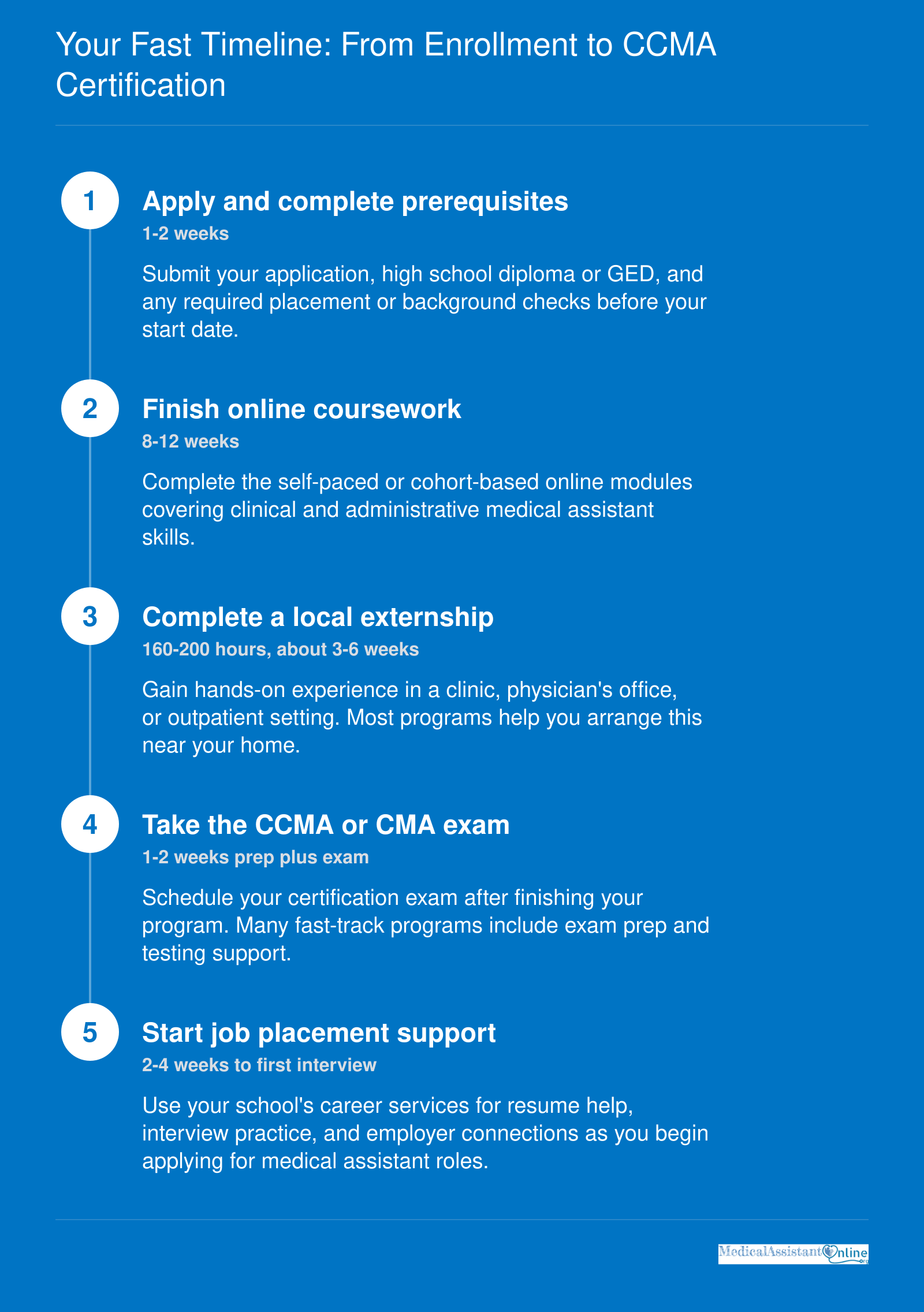
Your Fast Timeline: From Enrollment to CCMA Certification
In most fast-track online medical assistant certificate programs, you can move from application to certified and job-ready in roughly four to six months. The timeline below shows the typical sequence, assuming you can complete the online coursework on a full-time schedule and arrange your externship locally.
Medical Assistant Career Outlook for 2026: Why Fast Training Pays Off
Healthcare employers continue adding medical assistant positions faster than most other entry-level roles, a trend covered in the medical assistant vs other entry-level healthcare programs comparison, making accelerated training programs an attractive on-ramp to a stable career. The Bureau of Labor Statistics projects 15 percent job growth for medical assistants through 2032, well above the national average for all occupations.
Early-Career Earnings Expectations
Program-level earnings data one year after completion is not yet available for the six ranked schools in this guide. However, national data gives a useful benchmark: the median annual wage for medical assistants was approximately $42,000 in 2025, with entry-level positions typically starting between $32,000 and $38,000 depending on region and employer type. Graduates who complete fast-track programs and earn a CCMA credential often enter the workforce at the higher end of that entry range, especially in metropolitan areas or hospital systems.
Beyond the Paycheck
Medical assistant roles are entry-level, but they frequently come with employer-paid health insurance, retirement contributions, and paid time off. Many MAs also use the position as a stepping stone: clinical experience and patient interaction build a strong foundation for LPN programs or an MA to RN bridge program. If you are weighing the cost of a certificate against future earnings, consider that finishing quickly means you start earning, and gaining experience, months or even a full year sooner than students in longer programs.
Admissions Requirements and Prerequisites for Fast-Track MA Programs
Even the quickest online medical assistant certificate still asks you to clear a basic set of hurdles before you enroll. Across the programs featured here, you'll typically need a high school diploma or GED, and several schools, including Aiken Technical College and Skilltrade, also set a minimum age of 18.12 Most programs run a background check and drug screen3 before your medical assistant externship, since you'll eventually work with real patients. South College notes that failing a drug screen removes you from the program and blocks reapplication for 90 days, so this isn't a box to check casually.
Immunizations and Health Documentation
Expect to submit proof of MMR, Varicella, Tdap, and Hepatitis B vaccination, plus a current flu shot in season. Clackamas Community College Medical Assistant Program also asks for COVID-19 documentation, and Mt. Hood screens for amphetamines, barbiturates, opioids, benzodiazepines, and marijuana as part of its pre-clinical drug test.4
Program-Specific Extras
A few schools add their own wrinkles. The Christ College requires a 2.0 GPA from high school or transfer coursework.5 Northwood Technical College wants an official transcript plus state caregiver background checks.6 Notably, Skilltrade skips the background check and drug screen entirely for admission, though immunizations are still required for its hybrid clinical component.2
Some programs pair these requirements with a short orientation or informal interview before your first term starts, mainly to confirm you understand the clinical expectations ahead. Gathering immunization records and scheduling your background check early keeps your start date on track.
Related Articles
Additional Online Medical Assistant Certificate Programs to Consider
Looking for even more options? The schools below also offer online, hybrid, or accelerated medical assistant training. Each entry includes the school location, delivery format, and a link to the program page so you can compare your next steps.
- Medical Assistant
- Medical Assistant
- Medical Assisting Program
- Medical Assistant Program
- Medical Assisting Associate of Applied Science
- Intermediate Technical Certificate: Medical Assisting
- Certified Clinical Medical Assistant Apprenticeship
- Medical Assisting
- Medical Assistant Certificate
- Medical Assistant Program
- Medical Assistant
- Medical Assistant
- Medical Assisting Certificate Program
- Limited Medical Radiography with Medical Assisting
- Medical Assistant
- Medical Assisting
Recent Articles







- Medical Assistant Associate’s Degree: Is It Worth It? (2026) - April 22, 2025
- CMA vs RMA vs NCMA: Which MA Certification Is Right for You? - October 8, 2024
- The Evolving Role of Medical Assistants in Healthcare - January 3, 2024